Preparing a home for listing photos and showings often requires more than cleaning and decorating. Oversized furniture may need to be removed, seating may need to be repositioned, and personal belongings may need to be packed or moved into storage.
This is where in-home moving assistance can support the staging process. Professional movers in Dedham, MA can handle the physical work involved in rearranging rooms while the homeowner, real estate agent, or professional stager determines the final layout.
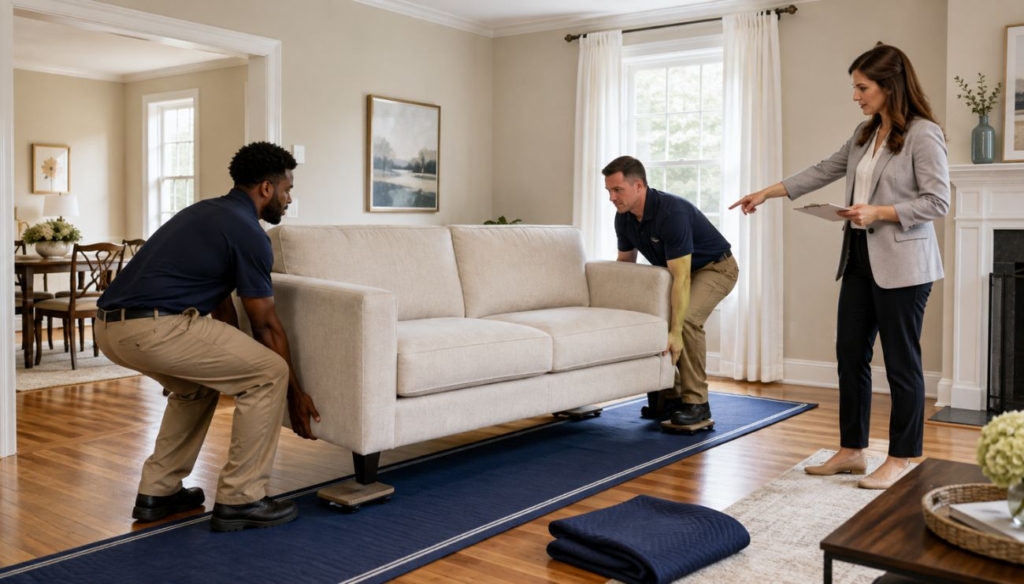
How In-Home Moving Supports Home Staging
Traditional moving usually involves transporting belongings from one address to another. An in-home moving project may remain entirely within the property. Furniture might be moved between rooms, relocated to another floor, placed in a garage, or prepared for off-site storage.
Home staging and moving are related services, but they are not the same. A home stager develops the visual plan. Movers provide the handling, protection, disassembly, and placement required to carry out that plan.
Depending on the project, moving assistance may include:
- Repositioning sofas, tables, beds, and storage furniture
- Moving oversized pieces out of visually crowded rooms
- Disassembling and reassembling compatible furniture
- Relocating packed belongings to another area of the home
- Preparing furniture for off-site storage
- Placing rented staging furniture according to a layout
- Protecting floors, walls, railings, and doorways during the work
What Research Says About Home Staging
Staging does not guarantee a faster sale or a higher offer. However, it can affect how buyers understand and experience a property.
According to the National Association of REALTORS® 2025 Profile of Home Staging, 83% of surveyed buyers’ agents said staging made it easier for buyers to visualize a property as their future home. The report also found that agents placed the greatest staging importance on the living room, primary bedroom, and kitchen.
The report’s findings on sale price and time on market were mixed. Some agents reported improvements, while others reported no measurable effect or were unsure. Sellers should therefore treat staging as a presentation and marketing strategy rather than a guaranteed financial return.
Start With a Room-by-Room Staging Plan
Moving furniture without an agreed layout can waste time and create unnecessary handling. Before the movers arrive, walk through the property with the real estate agent or stager and identify what should stay, move, or leave the home.
Create an item inventory
List each piece that requires attention and record its current and intended location. A practical inventory might include:
- Living room sectional: remove one section and reposition the remaining pieces
- Dining table: rotate and center beneath the light fixture
- Primary bedroom dresser: move to the guest room
- Bookcase: empty and relocate to storage
- Personal photographs and collections: pack for off-site storage
Photographs and a simple floor plan can help the moving crew understand the scope before work begins.
Confirm what can be disassembled
Removing legs, shelves, drawers, or detachable sections can make some furniture easier to move. Photograph the item before disassembly, label the hardware, and avoid forcing components that were not designed to separate.
Fragile artwork, mirrors, glass furniture, antiques, and other valuable pieces may require specialized preparation or custom packing and crating.
Measure the complete route
Measure furniture, doorways, stair openings, hallways, landings, and ceiling clearance. An item may fit through a doorway but still be unable to turn through an adjacent hallway or staircase.
Tell the movers about narrow stairs, loose railings, delicate flooring, low ceilings, or restricted parking when requesting the estimate.
Declutter Without Making the Home Feel Empty
The goal of decluttering is not to remove everything. It is to make each room easier to understand while allowing buyers to notice the home rather than the belongings.
Prioritize items that:
- Block doors, windows, or natural walking routes
- Make rooms appear crowded
- Hide built-in features or architectural details
- Create multiple competing uses within one room
- Are highly personal, fragile, or distracting
- Will not be needed before the seller moves
A small room may benefit from removing one oversized piece instead of following a rigid percentage rule. The correct amount depends on the room’s dimensions, furniture scale, photography angles, and intended use.
Pack smaller items before movers arrive. These packing and organization tips can help reduce loose items and simplify the staging process.
Arrange Furniture for Clear Movement and Purpose
Furniture placement should make it easy to enter, move through, and understand each room. Avoid arrangements that block doorways, windows, fireplaces, built-ins, or access to adjoining spaces.
Keep pathways open
There is no single clearance measurement that works in every home. Instead, confirm that primary walking routes feel comfortable and that doors, drawers, and cabinets can open normally.
Review the layout from the entrance to each room. If buyers would need to turn sideways, walk around an unnecessary obstacle, or step into a seating area to reach another room, reconsider the furniture placement.
Show each room’s intended function
Buyers should be able to recognize the purpose of a room quickly. A spare bedroom used as a storage area may be better presented as a bedroom or home office. An open floor plan may need carefully positioned furniture to distinguish the living and dining areas.
Avoid assigning too many purposes to one space. Clear furniture groupings generally communicate function more effectively than several small arrangements competing for attention.
Consider listing photographs
Walk through the likely photography angles after the furniture is positioned. Check whether oversized pieces dominate the frame or conceal important features. The photographer or real estate agent may request small adjustments before the session begins.
Storage Options During the Selling Process
Extra belongings generally fall into four categories:
- Keep in place: Items that support the staging plan or remain necessary for daily life
- Move elsewhere in the home: Items that can be stored neatly without crowding another visible area
- Move off-site: Furniture, boxes, and personal items that will not be needed before moving
- Sell, donate, recycle, or discard: Items the seller does not plan to keep
Garages, basements, attics, and closets are part of the property buyers evaluate. Filling them with staging overflow can make those spaces difficult to inspect and may reduce their perceived usefulness.
If on-site storage is necessary, keep the area organized, protect belongings from moisture or temperature changes, and maintain safe access to utilities, electrical panels, exits, and mechanical equipment.
Coordinate Movers, Stagers, and Real Estate Professionals
The homeowner should establish one point of contact who can approve furniture placement and answer questions during the project. This may be the homeowner, listing agent, or professional stager.
Before moving day, confirm:
- The complete furniture and box inventory
- The intended location of each item
- Whether items are staying on-site or moving off-site
- Who is responsible for packing and labeling
- Which furniture requires disassembly or reassembly
- When cleaning, staging, and photography will occur
- Whether a second visit may be needed after the property sells
Schedule the furniture work before final cleaning and photography whenever possible. Leave enough time to correct placement, clean areas previously covered by furniture, and make small adjustments without delaying the listing.
Labor-Only Help Versus Full-Service Moving
For a project limited to rearranging furniture inside the home, labor-only assistance may be sufficient. A full-service move may be more appropriate when furniture must be packed, loaded, transported, unloaded, or stored at another location.
The right option depends on the number of items, access conditions, transportation needs, project schedule, and whether packing materials or specialized handling are required. This guide to full-service and moving-help options explains the general differences.
Confirm the exact scope with the mover before booking. Not every labor-only service includes packing, furniture assembly, transportation, disposal, or storage.
Protect the Property During Furniture Rearrangement
A staging project should improve the home’s presentation, not create new scratches or wall damage. Protection may include secured floor runners, furniture blankets, corner guards, doorway protection, and padding around vulnerable railings.
Clear the route before lifting begins and keep children and pets away from the work area. Movers should stop if the item cannot be controlled safely or if the route is too restricted.
The Occupational Safety and Health Administration advises using mechanical assistance when appropriate, keeping loads close to the body, avoiding twisting, maintaining clear access, and getting additional help with heavy or bulky loads. See OSHA’s heavy-lifting safety guidance for more information.
What Affects the Cost of Staging-Related Moving Help?
Generic hourly rates do not provide an accurate estimate for every staging project. Pricing may depend on:
- Number, size, and weight of the items
- Number of movers required
- Project duration and company minimums
- Stairs, elevators, long carries, or restricted access
- Disassembly and reassembly requirements
- Packing and protection materials
- Transportation or off-site storage
- Special handling for fragile or valuable pieces
- Scheduling and return visits
To receive a useful estimate, provide photographs, measurements, the item list, access details, and the desired final locations. Ask which services and materials are included instead of relying on third-party pricing averages.
Home Staging Moving Checklist
- Walk through the property with the real estate agent or stager.
- Label every item as keep, reposition, store, sell, donate, or discard.
- Create a written item list and final room layout.
- Measure large furniture and the complete moving route.
- Pack personal belongings and fragile décor.
- Confirm disassembly, transportation, and storage requirements.
- Clear walkways and protect children and pets from the work area.
- Schedule moving before final cleaning and photography.
- Review each room from the doorway and likely photography angles.
- Keep hardware and removed components labeled for the final move.
Frequently Asked Questions
Can movers help stage a home?
Movers can handle furniture rearrangement, packing, disassembly, placement, and transportation when those services are included in the project. They do not replace a professional home stager unless the company specifically offers staging design.
Do I need a professional stager?
Not every seller hires one. Some follow recommendations from their real estate agent, while others pay for a staging consultation and hire movers to execute the plan. The appropriate approach depends on the property, market, budget, and listing strategy.
How much furniture should I remove?
There is no universal percentage. Remove enough to improve movement, reveal important features, and communicate each room’s purpose without making the home look vacant or impractical.
Can I store extra furniture in the garage or basement?
Yes, if the space remains organized, accessible, and safe. Remember that buyers may inspect storage and utility areas. Off-site storage may be preferable when furniture would crowd those spaces.
How much does staging-related moving help cost?
Pricing depends on the project’s labor, access, furniture, disassembly, protection, transportation, and scheduling requirements. Request a project-specific estimate based on photographs and a complete item list.
Does home staging guarantee a faster sale or higher offer?
No. Staging may help buyers understand a property and may improve its presentation, but market conditions, price, location, condition, and buyer demand also affect the outcome.
Prepare Your Dedham Home for Listing
A successful staging move begins with a clear plan. Decide what stays, where each piece belongs, which items need storage, and who can approve the final arrangement. Then provide the mover with enough information to estimate and schedule the work accurately.
Lifetime Moving Co offers residential moving assistance for household projects in Massachusetts. To discuss furniture rearrangement, packing, or transportation for a Dedham property, contact Lifetime Moving Co with photographs, measurements, and the requested project date.