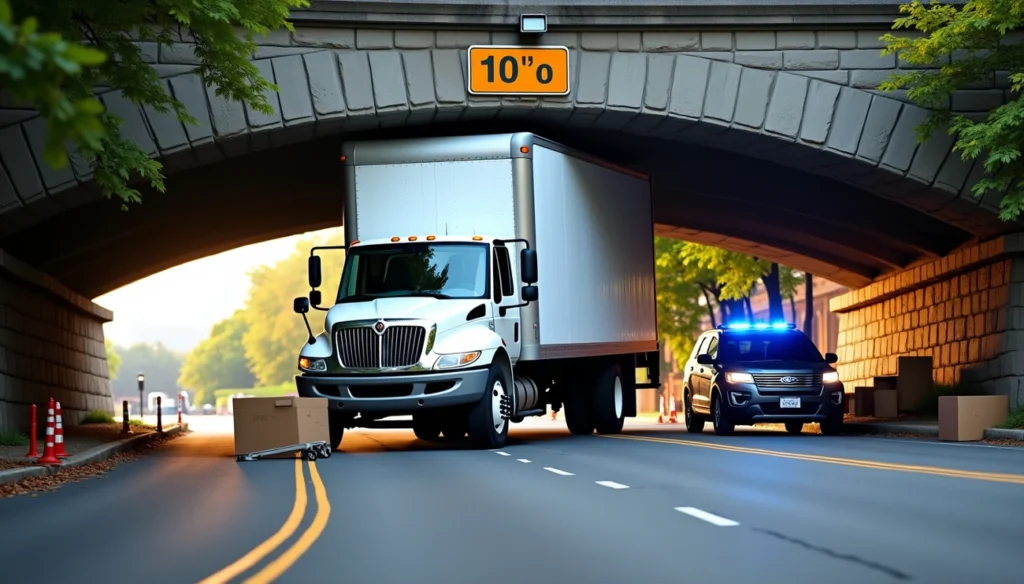
Boston moving day brings unmatched chaos. Each year from late August through early September, more than 150,000 students at dozens of colleges move in around the same time. Nearly 80% of long-distance moves in the US happen during summer. Boston's notorious traffic amplifies the challenge. Getting "Storrowed" is one way to make your move go viral for all the wrong reasons. Bridges along Storrow Drive and Memorial Drive have clearances as low as 9 feet, yet standard moving trucks stand 11-13.5 feet tall. This piece will help you guide yourself through Boston's restricted parkways during the infamous September 1 moving day rush.
What Does 'Getting Storrowed' Mean?
The origin of the term
"Storrowed" describes what happens when a truck crashes into one of the low bridges on Storrow Drive, often with the roof peeling back like a sardine can. The term has become so embedded in Boston culture that it earned its own Urban Dictionary entry. Bostonians take pride in this local vocabulary and use it to distinguish themselves from outsiders who become victims of the city's notorious parkway.
The phenomenon predates the road itself. A photo from 1906 shows a horse-drawn cart hitting a trolley wire in what could be called a historical "Storrowing". Storrow Drive was built as a parkway in 1951 with permanent truck and bus restrictions, and the problem has persisted for decades. The term now applies to any truck-hitting-bridge incident around New England.
Why it happens so often on Boston moving day
The numbers tell a sobering story. We've seen 14 bridge strikes along Storrow Drive and Soldiers Field Road in 2024, trending toward the highest count in a decade. One August alone tallied 34 bridge strikes or back-outs. The Harvard Street Bridge has suffered over 30 strikes over the last ten years.
GPS misguidance shoulders much of the blame. Google Maps and similar navigation apps don't account for height restrictions and lead unsuspecting drivers straight into danger. U-Haul Boston loses around 10 trucks per college move-in season despite warning customers.
Professional drivers cause most incidents, in stark comparison to popular belief. One Boston moving company owner observed that professional drivers unfamiliar with the area make these mistakes much more often than college students. Recent examples include a Martha's Vineyard oyster delivery truck and a driver from Alabama. One incident involved a driver on his first day from a small New Hampshire town.
Real costs: damage, fines, and delays
Vehicle damage ranges from $1,000 for tree branch scrapes on Memorial Drive to $35,000 for bridge collisions. Standard insurance from moving companies doesn't cover this damage since hitting a marked bridge counts as negligence.
Fines add up fast. Drivers face up to $50 for illegal vehicle operation on the parkway, plus up to $150 for failure to obey signage. The city may also seek compensation for infrastructure damage.
Traffic snarls can last hours beyond the financial hit. One tractor-trailer remained stuck for seven hours before crews could remove it. The embarrassment factor might hurt worse than the bills.
Understanding Storrow Drive Height Limits and Why Your Truck Won't Fit
The 10-foot clearance problem
Storrow Drive operates under a deceptively simple restriction: a maximum clearance of just 10 feet. Some overpasses drop even lower, with height restrictions as low as 9 feet. Passenger cars were the only vehicles considered when these parkways were designed, which explains why Massachusetts designates Storrow Drive, Memorial Drive, and Soldiers Field Road as "cars only" routes[91].
Massachusetts State Police respond to multiple incidents each year where trucks either become wedged under bridges or require slow, embarrassing back-outs from overpasses[91]. The gap between legal clearance and actual truck height creates zero margin for error, and the problem persists.
Standard moving truck heights (11-13.5 feet)
Standard rental trucks from U-Haul, Penske, and Ryder stand between 11 and 13 feet 6 inches tall. To name just one example, a typical 15-foot box truck measures around 11 feet in exterior height, while larger 26-foot trucks can reach 13.5 feet.
Then every common moving truck exceeds Storrow Drive's clearance by at least one foot. The math doesn't work, period.
Bridge-by-bridge height restrictions
The entire network of restricted parkways shares similarly dangerous clearances. Storrow Drive, Memorial Drive, and Soldiers Field Road all maintain height restrictions in the 9-10 foot range[91]. No single bridge offers safe passage for a standard moving truck.
Winter and weather clearance buffers
6 inches to your truck's listed height should be added when planning routes during winter moves. This safety buffer accounts for snow accumulation on the truck roof and measurement variations in cold weather conditions. A truck listed at 11 feet should be treated as 11.5 feet tall between November and March.
Snow and ice change the equation entirely and make already tight clearances impossible.
Why Your GPS Is Sending You the Wrong Way
Google Maps and Waze don't track truck height
Standard navigation apps create a dangerous blind spot for moving truck drivers. Google Maps has no dedicated truck routing profile in most consumer apps. Waze only offers route options for cars, taxis and motorcycles. Neither platform accounts for height restrictions, weight limits or truck-prohibited roads.
Waze wasn't designed for truck navigation and could send you down weight-restricted roads, under low-clearance bridges or into dangerous areas for truckers. Google Maps might work if you already know the area well. Unfamiliar drivers risk serious accidents when they rely on passenger vehicle routing. One trucker who used standard GPS wound up with his 18-wheeler overturned and hanging off a mountainside.
Truck-specific GPS apps: TruckMap and Hammer
TruckMap and Hammer solve the height problem. They build routes for commercial vehicles. TruckMap provides truck-optimized GPS routes with turn-by-turn navigation that accounts for vehicle height, weight and HAZMAT restrictions. The platform lists over 400,000 truck parking spots that drivers update 24/7.
Hammer delivers precision routing with safety-first features. The TruckersReport.com community built these features. The app accounts for your truck's height, weight, length, axle count and cargo type to give you customized directions. Hammer checks for truck-restricted roads, weight restrictions and low bridges when it calculates your route.
How to set up truck routing before you drive
Enter your truck's exact dimensions before you plan any route. Both apps require accurate vehicle height, weight and length for proper routing. Missing or incorrect truck dimensions will generate routes with dangerous clearances.
Download offline maps for your route. TruckMap and Hammer both offer offline map access that keeps you on track without cellular data[142].
Boston truck routes you can actually use
Use I-90, I-93 and Route 128 as your main corridors. Take I-93 to designated surface streets rather than parkways for downtown access. Commonwealth Avenue and Beacon Street work as safe surface street alternatives to Storrow Drive.
Essential Route Planning: Safe Alternatives to Storrow Drive
Major highways: I-90, I-93, and Route 128
I-90 (Massachusetts Turnpike) serves as your main east-west corridor with 13 feet 6 inches clearance. This toll road handles heavy vehicles without restrictions. I-93 manages north-south traffic through downtown and remains open to commercial vehicles. Route 128 (the outer beltway) lets you bypass the city center if your trip doesn't require downtown access.
Surface street alternatives: Commonwealth Avenue and Beacon Street
Commonwealth Avenue and Beacon Street run parallel to Storrow Drive and accommodate all vehicle types year-round. The Massachusetts Department of Conservation and Recreation recommends these routes as safe alternatives.
Navigating tight neighborhoods
North End and Beacon Hill feature narrow streets with sharp turns and NO TRUCK signs that protect aging infrastructure. Professional movers handle these areas daily. Inexperienced drivers should avoid them.
Boston moving day and why September 1 matters
September 1 marks boston moving day. Around 70% of leases across the city end simultaneously. The city issues 16,000 to 20,000 permits from June through August. This concentration creates major congestion.
Permit requirements and reserved parking spots
Apply through [Boston.gov/moving](https://www.boston.gov/moving) at least 15 days before your move for online applications. Standard permits cost USD 69.00 for non-metered spaces or USD 109.00 with meters. Visit Lifetime Moving Co. to get professional assistance, or contact our Boston movers directly. Protect your roof and your deposit with a safe, Storrow-free Boston move.
Conclusion
Boston's parkways weren't built for moving trucks, and the math proves it. Standard trucks stand 11-13.5 feet tall while Storrow Drive clearances max out at 10 feet. GPS apps like Google Maps won't save you, especially during September 1 chaos. We've shown you truck-specific apps and safe alternatives that work. Protect your roof and your deposit with proper route planning, or better yet, hire professional movers who handle these restrictions daily. A safe, Storrow-free Boston move starts with the right preparation.
FAQs
Q1. What does "getting Storrowed" mean and why does it happen so often? "Getting Storrowed" refers to when a truck crashes into one of the low-clearance bridges on Storrow Drive, often peeling back the roof like a can opener. It happens frequently because GPS apps like Google Maps don't account for height restrictions and route trucks onto these restricted parkways. The problem intensifies during Boston's moving season, particularly around September 1, when thousands of people move simultaneously and unfamiliar drivers rely on standard navigation apps that lead them directly into danger.
Q2. What are the height restrictions on Storrow Drive and how tall are typical moving trucks? Storrow Drive has a maximum clearance of only 10 feet, with some bridges as low as 9 feet. Standard rental moving trucks from companies like U-Haul, Penske, and Ryder stand between 11 and 13.5 feet tall. This means every common moving truck exceeds the clearance by at least one foot, making it physically impossible to pass under these bridges safely. During winter, you should add an additional 6 inches to account for snow accumulation on the roof.
Q3. Why can't I use Google Maps or Waze for truck navigation in Boston? Standard navigation apps like Google Maps and Waze are designed for passenger vehicles and don't have truck routing profiles. They don't account for height restrictions, weight limits, or truck-prohibited roads, which can lead drivers straight into dangerous situations. Instead, use truck-specific GPS apps like TruckMap or Hammer, which allow you to enter your vehicle's exact dimensions and will calculate routes that avoid low bridges and restricted roads.
Q4. What are safe alternative routes to Storrow Drive for moving trucks? Use major highways like I-90 (Massachusetts Turnpike), I-93, and Route 128 as your primary corridors—these roads accommodate commercial vehicles with proper clearances. For surface street alternatives, Commonwealth Avenue and Beacon Street run parallel to Storrow Drive and are safe for all vehicle types. Avoid Memorial Drive on the Cambridge side as well, since it has the same low-clearance restrictions as Storrow Drive.
Q5. Do I need a permit for moving in Boston, and what are the consequences of driving illegally on Storrow Drive? Yes, you should apply for a moving permit through Boston.gov at least 15 days before your move. Standard permits cost $69 for non-metered spaces or $109 with meters. If you illegally drive on Storrow Drive, you face fines up to $200, vehicle damage ranging from $1,000 to $35,000 that insurance typically won't cover, and potential traffic delays lasting hours. Professional movers familiar with Boston's restrictions can help you avoid these costly mistakes.