Getting "storrowed" on Boston's infamous Storrow Drive height limit of just 10 feet is the city's most predictable traffic disaster, especially during moving season.
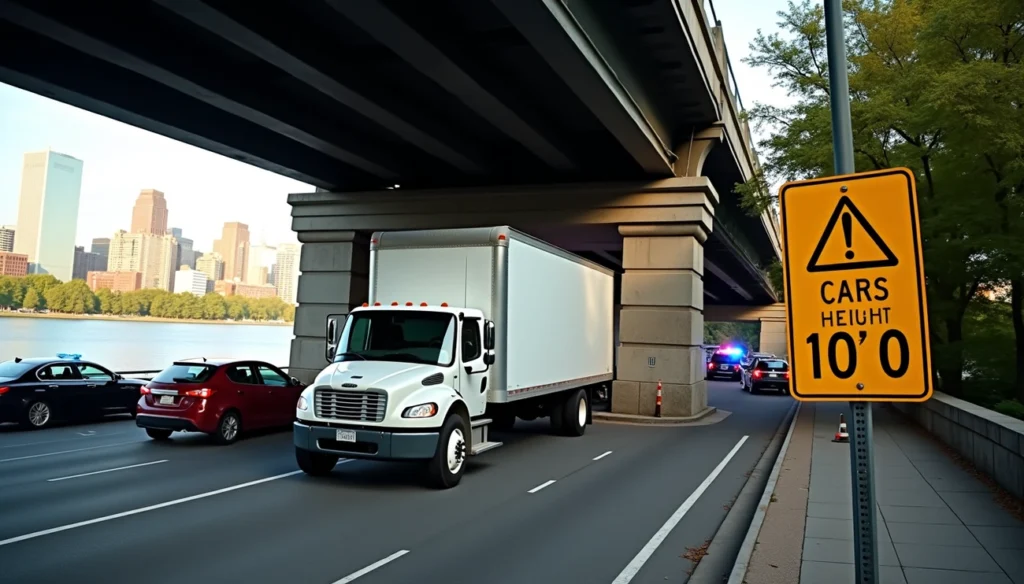
Getting storrowed means crashing your moving truck into one of the low-clearance bridges along Storrow Drive, Memorial Drive, or Soldiers Field Road. These roadways have height restrictions as low as 9 feet in some locations. Most moving trucks range from 11 feet up to 13 feet 6 inches in clearance. Standard GPS apps like Google Maps won't warn you about these overhead limits and will direct trucks straight into expensive collisions.
This step-by-step guide will help you check your storrow drive truck clearance, use proper Boston truck routes, and move safely with your truck through Boston.
Understanding the Storrow Drive Height Limit and Bridge Clearances
What Is the Exact Height Limit on Storrow Drive
The official height restriction on Storrow Drive is 10 feet for the entire parkway. But certain overpasses drop even lower, with clearances reaching as little as 9 feet in specific locations. The Department of Conservation and Recreation (DCR) designates these roads as "cars only" and hangs warning signs at the approximate height of the bridges. Drivers know they'll hit the bridge itself at the time a vehicle strikes these signs.
Memorial Drive and Soldiers Field Road Restrictions
Memorial Drive in Cambridge and Soldiers Field Road in Boston share similar restrictions with Storrow Drive. Both routes have the same "cars only" designation and height restrictions as low as 9 feet. The highest bridge clearance for both roads reaches only 10 feet. Massachusetts agencies manage all three parkways along the Charles River and enforce prohibitions against commercial vehicles, moving trucks, and box trucks.
Why Standard Moving Trucks Can't Use These Routes
Standard rental trucks from U-Haul, Penske, and Ryder measure between 11 and 13 feet 6 inches tall. The maximum clearance on these parkways is 10 feet, so no standard moving truck can pass under the bridges safely. Massachusetts State Police respond to multiple incidents each year with trucks stuck under bridges or drivers attempting to back out from overpasses. There were 14 bridge strikes along Storrow Drive and Soldiers Field Road in 2024. Hot spots include the CSX rail bridge near the BU Bridge and the Harvard Street Bridge, which has experienced over 30 strikes over the last several years.
The Ground Cost of Getting Storrowed: Damage Fees and Fines
Storrowed drivers face severe financial consequences. Roof damage ranges from $1,000 at the time tree branches scrape the truck on Memorial Drive to $35,000 for bridge collision incidents. One Boston movers company reports losing around 10 trucks per college move-in season annually.
Drivers also face legal penalties. Operating a prohibited vehicle on the parkway results in a $50 fine, while failure to obey signage adds another $150. Standard insurance from rental companies doesn't cover bridge strikes since hitting marked overhead structures qualifies as negligence.
How to Check Your Moving Truck Height Before You Drive
Step 1: Find Your Truck's Exact Height Specification
Most rental trucks display height information on stickers inside the cab. Check the sun visor, dashboard, or windshield for decals showing vehicle height. Penske trucks place these stickers on the front windshield and the side of the vehicle, viewable from the driver's side mirror. Look at your rental agreement if you don't see a sticker, which lists the truck's height. Call the rental company for exact specifications when neither option works.
Step 2: Write Down the Height and Keep It Visible
Post your truck's height measurement where you can see it while driving. Write it on a sticky note. Place it on the dashboard or steering column. This visible reminder helps you reference your clearance when approaching bridges or overpasses. Having this number in sight prevents dangerous guesswork when you're navigating unfamiliar Boston streets.
Step 3: Add 6 Inches for Safety Margin
Add at least a half-foot buffer to your truck's actual height. Road resurfacing, hard-packed snow, and ice can add inches to pavement height[102]. Posted bridge clearances already account for some variance, but additional margin protects against measurement discrepancies. Your truck measures 11 feet tall? Treat it as 11 feet 6 inches when evaluating clearances.
Step 4: Compare Against the 10-Foot Storrow Drive Clearance
Compare your adjusted height against Storrow Drive's 10-foot maximum clearance. Any truck measuring over 10 feet 6 inches (including your safety buffer) cannot travel these parkways safely. Standard rental trucks range from 11 to 13 feet 6 inches, making them incompatible with Storrow Drive, Memorial Drive, and Soldiers Field Road.
Using Truck-Specific GPS Apps to Avoid Low Clearance Bridges
Why Google Maps and Waze Don't Work for Moving Trucks
Consumer GPS applications route vehicles based on traffic speed and general road access, not commercial restrictions. Google Maps has no truck mode and never will, as trucking represents too small a user base for the required infrastructure investment. Then these apps will route your 13-foot moving truck straight under a 10-foot bridge without warning.
Apple Maps, Google Maps, and Waze have zero bridge clearance awareness. They cannot account for vehicle height, weight limits, or truck-prohibited roads. To cite an instance, a consumer GPS might route a 13-foot 6-inch truck under a 12-foot 6-inch bridge without any alert. This oversight causes preventable bridge strikes during Boston's moving season.
SmartTruckRoute: Boston's Recommended Navigation Tool
SmartTruckRoute creates truck-specific routes that account for bridge heights, load limits, one-way designations, and sharp turns. The app bases navigation on 40 years of accumulated proprietary data with daily updates for temporary and permanent road restrictions. Pricing runs $15.95 monthly, $59 annually, or $129 for three years without auto-renewal.
Commercial drivers input truck dimensions that include height, width, length, weight, and hazmat level to route accurately. SmartTruckRoute avoids low bridges and parkways like Storrow Drive while directing trucks to appropriate dock entrances.
Other Truck GPS Options: TruckMap and Hammer
TruckMap offers free truck-optimized GPS with customizable routes based on vehicle height, weight, and hazmat status. The app has an extensive database with over 600,000 truck-specific facilities and provides alerts about low clearances and weight restrictions in real time.
Hammer, built by the TruckersReport.com community, delivers free truck-specific navigation with routing for vehicle height, weight, length, and axle count. The app has offline map access and reroutes around traffic and road closures in real time.
How to Input Your Vehicle Dimensions in Navigation Apps
Go to vehicle settings or profile configuration within your chosen app. Enter your truck's exact height measurement first, as this prevents low bridge routing. Add weight, length, and width specifications next. Settings left at zero won't factor into route restrictions, so input all applicable dimensions.
Safe Alternative Routes: Boston Truck-Approved Corridors
Massachusetts Turnpike (I-90): Your Primary East-West Route
The Massachusetts Turnpike (I-90) is the main east-west corridor for truck traffic through Boston. This controlled-access toll road spans 138 miles from the New York state line through downtown Boston. I-90 provides full interstate vertical clearance standards and makes it the safest route for Boston movers avoiding the Storrow Drive height limit.
Interstate 93 for North-South Travel
I-93 handles the main north-south route through downtown Boston. This corridor provides direct access to the city center with proper clearances for commercial vehicles. But tunnel restrictions apply in certain sections, so verify your route before entering underground portions.
Beacon Street and Commonwealth Avenue as Surface Alternatives
Beacon Street and Commonwealth Avenue offer parallel east-west surface routes for moving trucks. These all-weather roads accommodate all vehicle types without the 10-foot clearances that make Storrow Drive hazardous. The Mass Conservation and Recreation Parkway Rules recommend these alternatives.
Crossing the Charles River: Truck-Safe Bridge Options
All bridges east of the Eliot Bridge allow trucks, including the BU Bridge and Longfellow Bridge. These crossings provide safe passage between Boston and Cambridge for standard moving trucks measuring 11 to 13 feet 6 inches tall.
Conclusion
Everything you need to avoid getting storrowed during your Boston move is now at your fingertips. The 10-foot clearance restriction makes Storrow Drive, Memorial Drive, and Soldiers Field Road off-limits for standard rental trucks. Standard GPS apps won't protect you, so use truck-specific navigation like SmartTruckRoute. Stick to I-90 and I-93 as your main corridors and double-check your truck's height before you start driving. Prevention costs nothing, but bridge strikes cost thousands.
Key Takeaways
Moving to Boston requires careful height planning to avoid costly "storrowing" incidents on the city's notoriously low bridges.
• Know your truck's height and add 6 inches safety margin - Standard rental trucks (11-13.6 feet) cannot safely navigate Storrow Drive's 10-foot clearance limit.
• Use truck-specific GPS apps like SmartTruckRoute - Google Maps and Waze don't account for bridge heights and will route you into dangerous low-clearance areas.
• Stick to I-90 and I-93 as primary routes - These interstate corridors provide safe truck passage through Boston with proper clearances for all commercial vehicles.
• Bridge strikes cost $1,000-$35,000 in damages plus fines - Prevention through proper route planning costs nothing compared to collision repairs and legal penalties.
Getting storrowed is completely preventable with the right preparation. Check your truck specifications, download proper navigation tools, and use designated truck routes to ensure a smooth, damage-free Boston move.
FAQs
Q1. What is the maximum height clearance allowed on Storrow Drive? Storrow Drive has a 10-foot height restriction for the entire parkway, though some overpasses have clearances as low as 9 feet in certain spots. Since standard moving trucks typically measure between 11 and 13.5 feet tall, they cannot safely pass under these bridges.
Q2. Why can't I use Google Maps or Waze when driving a moving truck in Boston? Consumer GPS apps like Google Maps and Waze don't have truck routing capabilities and cannot account for vehicle height, bridge clearances, or truck-prohibited roads. These apps will route your moving truck based solely on traffic speed without warning you about low-clearance bridges, potentially directing you straight into a collision.
Q3. How do I find out my rental truck's exact height? Check for height stickers inside the cab on the sun visor, dashboard, or windshield. If you don't find a sticker, look at your rental agreement which typically lists the vehicle's height. You can also call the rental company directly for exact specifications. Always add at least 6 inches to this measurement as a safety buffer.
Q4. What are the safe alternative routes to Storrow Drive for moving trucks? The Massachusetts Turnpike (I-90) serves as the primary east-west route, while Interstate 93 handles north-south travel through Boston. For surface alternatives, use Beacon Street or Commonwealth Avenue. When crossing the Charles River, stick to truck-safe bridges like the BU Bridge, Harvard Bridge, or Longfellow Bridge.
Q5. What happens if I get "storrowed" and hit a bridge? Bridge strikes result in significant financial consequences, with damage costs ranging from $1,000 to $35,000. You'll also face legal penalties including a $50 fine for operating a prohibited vehicle on the parkway and an additional $150 for failure to obey signage. Standard rental insurance won't cover these damages since hitting clearly marked structures is considered negligence.