Skip the Boston moving permit process, and you could face fines starting at $90 or even get your truck towed. Parking a moving truck in Boston without proper authorization isn't just inconvenient; it can derail your whole move and drain your wallet.
Here's what we want you to know: securing a city of boston moving permit requires planning ahead. The standard permit costs $69 for two non-metered spaces, with an additional $40 per meter if your spot has metered parking. You'll also need to post official Boston moving signs at least 48 hours before your move date.
In this piece, we'll walk you through the complete 2026 permit process. We break down fees and posting requirements. You'll learn exactly how to reserve moving truck parking Boston the right way.
What is a Boston Moving Permit and Do You Need One?
What is a city of boston moving permit?
A Boston moving permit, officially called a Temporary Street Occupancy Permit, grants you legal authority to occupy public street space with your moving truck for a designated time window. The permit reserves around 40 feet of curbside space, equivalent to two standard parking spots, directly in front of your move address.
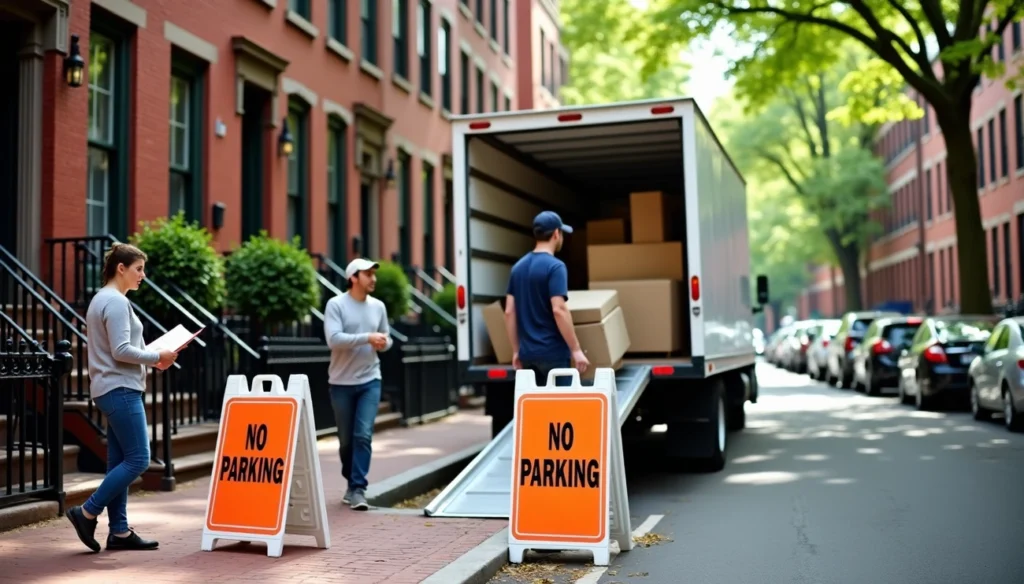
The city issues two official "No Parking" signs with each permit. You must install these Boston moving signs at the designated location before your scheduled move time. Any vehicle parked in your reserved zone after proper sign posting becomes subject to citation and towing at the owner's expense.
The standard permit runs from 7 a.m. to 5 p.m. for one day. You can extend reservations for up to five consecutive days. After that original five-day period, the city requires a 48-hour break to allow public access to the space again.
When do you need a Boston moving truck permit?
You need a boston street occupancy permit whenever you plan to park a commercial vehicle for loading or unloading on a public street within city limits. This applies to both residential zones and metered areas in neighborhoods of all types.
The permit becomes especially important in congested areas such as Beacon Hill, the South End, Jamaica Plain, Allston, Brighton, and Charlestown. The North End has special rules. You must get permission from the Boston Transportation Department between July 1 and August 31 before applying for your permit.
You can skip the permit process if your move occurs entirely within a private parking lot or if your building has a private loading dock that doesn't require street occupation. Some locations between August 31 and September 2 are blocked off for moving truck drop-offs and don't require permits.
Consequences of moving without a permit
You risk parking citations starting at around $40 if you move without a permit. Double-parking or fire hydrant violations carry much higher fines. Towing fees range from $200 to $350, way more than what you'd pay for the permit itself.
Beyond monetary penalties, unpermitted moves create logistical problems. Your moving crew may spend 30 to 90 minutes repositioning the truck and managing parking enforcement interactions. Boston mover rates of $80 to $150 per hour for a three-person crew mean these delays cost $40 to $225 in additional labor.
2026 Boston Moving Permit Fees and Costs
Base permit fee for non-metered spaces
The standard city of boston moving permit costs $69 for a one-day reservation covering two non-metered parking spaces. This base rate has two official "No Parking" signs at $4 each, a $50 application processing fee, and a space calculation charge of around $11 (calculated at $1 per square foot per month for a typical 40-foot by 8-foot zone, prorated to one day).
Additional costs for metered parking areas
Metered locations need an extra $40 per day surcharge and bring your total to around $109 to $110 for a standard two-space boston moving truck permit. This metered fee breaks down to $20 per meter per day. If you reserve two metered spaces in Back Bay or Downtown, you pay the $69 base rate plus $40 for the meters.
The detailed cost formula works as follows: $50 base application fee, plus $11 for space calculation (40 feet × 8 feet × one day), plus $8 for two signs, plus $40 for two metered spaces equals $109 total.
Extra charges for signs and extended reservations
Multi-day permits increase costs in proportion. A two-day boston temporary parking permit for non-metered spaces runs around $130 to $140. Late applications submitted fewer than three business days before your move date incur a $20 flat surcharge and raise a standard non-metered permit to $89.
Payment methods and processing fees
The city accepts cash, Visa, MasterCard and American Express. Credit card and debit card transactions carry a non-refundable 2.5% processing fee with a $1 minimum that you pay to the card processor. Personal checks are no longer accepted for boston parking permit moving applications, effective February 10, 2020.
How to Get a Boston Moving Permit: Step-by-Step Process
Step 1: Determine your move date and location
Gather precise details before starting your boston moving permit application. You'll need the exact street address where the truck will park and the specific side of the street (even or odd-numbered). Your move start and end times matter, as does the vehicle type. The permit becomes unenforceable if you provide incorrect address information.
Step 2: Check street availability and restrictions
Before applying, verify your chosen location allows moving trucks. The city maintains an online Street Occupancy Permit database at cityofboston.gov. You can search for existing permits and conflicts there. Certain state-owned roads cannot receive city permits. These include Boylston Street (1101-1209), Charlesgate East and West, Park Drive (11-468), Fenway, Riverway, Arborway, and Jamaicaway. Moves in the North End between July 1 and August 31 require pre-approval from the Boston Transportation Department at 617-635-2560 before you apply.
Step 3: Apply online or in person
Moves scheduled 15 days to eight weeks away can be handled through the official portal at boston.gov/moving. The online system handles standard one-day, two-space permits only. Moves fewer than 15 days out require an in-person application at the Parking Clerk's Office on the second floor of City Hall. You must apply at least three business days before your move date[142]. Applications submitted with less than three days' notice incur a $20 late fee.
Step 4: Pay the permit fees
Submit payment during application using accepted methods covered in the fees section above.
Step 5: Receive your permit and Boston moving signs
The city mails your permit and two official signs to your registered address once approved. Expect delivery within 10 days of approval. If materials don't arrive, contact the Parking Clerk's Office at 617-635-2560 at least three days before your move.
Step 6: Post no parking signs 48 hours in advance
Attach signs to utility poles, fences, or fixed objects at both ends of your reserved 40-foot zone. You must do this at least 48 hours before your 7 a.m. start time. Take photos as proof of proper posting.
Boston Moving Permit Rules and Signage Requirements
The 48-hour sign posting requirement
Boston enforces strict timing for sign installation. You must post your official "No Parking" signs at least 48 hours before your 7 a.m. permit start time for non-metered spaces. Metered locations require signs posted 24 hours in advance. Your move starts Saturday at 7 a.m.? Post signs by Thursday at 7 a.m. for non-metered spots or Friday at 7 a.m. for metered areas.
Where and how to post your signs correctly
Attach signs to utility poles or parking meters at both ends of your reserved zone and at regular intervals. Do not place signs on fire hydrants, at crosswalks, or within 10 feet of driveways. Use zip ties or strong tape to prevent wind or rain from removing them. Photograph your posted signs as proof of compliance.
What to do if someone parks in your reserved spot
Call 911 if a vehicle occupies your permitted space. State "this is not an emergency" right away to avoid tying up emergency resources. Boston requires police authorization before towing. Officers will run the plate and attempt to contact the owner for voluntary removal. This process takes two hours or longer, and you remain responsible for mover time during delays.
Permit enforcement and parking violations
Display your permit on the truck's dashboard for parking enforcement visibility. Document the reserved area with photos. You receive a ticket despite proper permitting? Contest it through the city's online appeal process using your sign photos and permit copy as evidence.
Removing signs after your move
Take down all signs and tape after your move. Dispose of materials rather than leaving them posted. Failure to remove signs may result in fines.
Conclusion
You now have everything you need to secure your Boston moving permit and avoid pricey fines or towing fees. Note that you must apply at least three business days ahead, budget $69 for non-metered spaces or $109 for metered areas, and post your signs 48 hours early.
Confused by the permit process? Let Lifetime Moving Co. guide you through every step. Get a free quote for your permitted Boston move today and move with complete peace of mind.
Key Takeaways
Moving in Boston without a permit can cost you $90+ in fines plus towing fees up to $350, making the $69 permit fee a smart investment.
• Apply for your Boston moving permit at least 3 business days before your move to avoid $20 late fees • Budget $69 for non-metered spaces or $109 for metered parking areas in your moving costs • Post official "No Parking" signs 48 hours before your move (24 hours for metered spots) to legally reserve space • Call 911 if someone parks in your permitted spot - police authorization is required before towing • Take photos of posted signs and your permit as proof of compliance in case of parking disputes
The permit reserves 40 feet of street space (two parking spots) from 7 a.m. to 5 p.m., giving your moving truck legal access to Boston's crowded streets. Proper planning and early application ensure a smooth, penalty-free moving day.
FAQs
Q1. How can I apply for a moving permit in Boston? You can apply online through the official portal at boston.gov/moving for moves scheduled 15 days to eight weeks in advance. For moves fewer than 15 days away, you'll need to apply in person at the Parking Clerk's Office on the second floor of City Hall, located at One City Hall Square. The office operates Monday through Friday, 9:00 A.M. to 5:00 P.M.
Q2. What are the fees for a Boston moving permit in 2026? The standard permit costs $69 for two non-metered parking spaces. If your reserved spot includes metered parking areas, you'll pay an additional $40 per meter, bringing the total to approximately $109. Applications submitted fewer than three business days before your move date incur an additional $20 late fee.
Q3. When do I need to post the no parking signs for my move? You must post the official "No Parking" signs at least 48 hours before your 7 a.m. permit start time for non-metered spaces. For metered locations, signs need to be posted 24 hours in advance. Make sure to attach them securely at both ends of your reserved zone and take photos as proof of proper posting.
Q4. What payment methods are accepted for Boston moving permits? The city accepts cash, Visa, MasterCard, Discover, American Express, and pinless debit cards. Credit card and debit card transactions carry a 2.5% processing fee with a $1 minimum. Personal checks are no longer accepted for moving permit applications.
Q5. What should I do if someone parks in my reserved moving spot? Call 911 and immediately state "this is not an emergency." Boston requires police authorization before towing any vehicle from your permitted space. Officers will run the plate and attempt to contact the owner for voluntary removal. This process can take two hours or longer, so factor in potential delays when scheduling your move.