To work out how to get a couch through a door, measure both the furniture and the complete route before lifting anything. Doorway width matters, but so do the couch's rigid frame, the opening height, and the space available to turn on either side.
No single diagonal measurement or standard door size guarantees a fit. This guide explains what to record before moving a couch inside your Cambridge home and what to share when requesting help from Lifetime Moving Co.
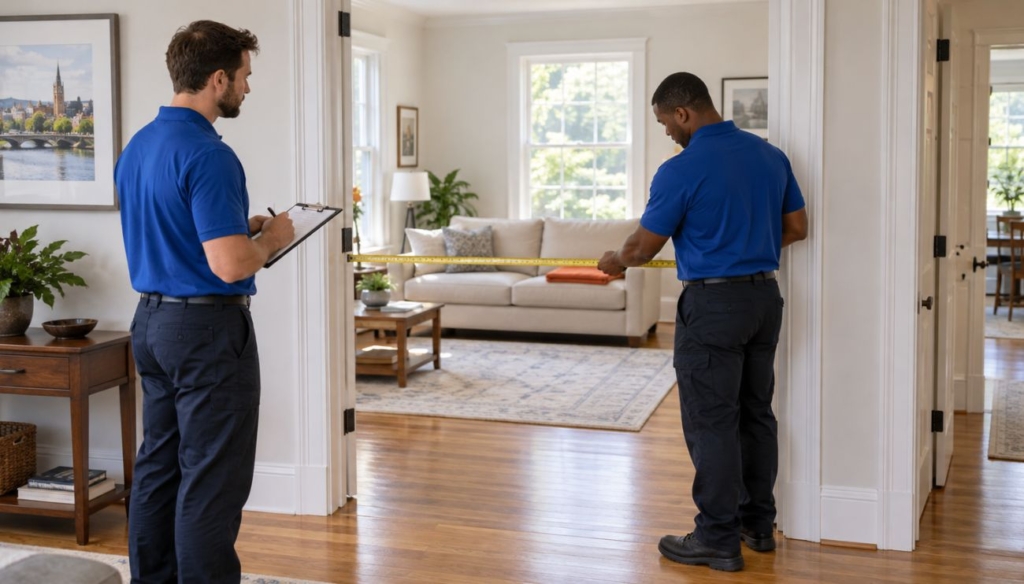
1. Measure the Couch at Its Widest Points
Use a tape measure and record all dimensions in the same units. Start with the couch as it currently stands, then note any smaller dimensions that depend on manufacturer-approved removal of parts.
- Overall length: Measure from the outermost point at one end to the outermost point at the other, including curved or rolled arms.
- Overall depth: Measure from the furthest point at the back to the furthest point at the front. Include projecting cushions or frame parts.
- Overall height: Measure from the floor to the highest point, including feet and back cushions.
- Rigid frame dimensions: Record the frame's size separately if loose cushions can be removed. Do not assume attached padding can be compressed enough to solve a clearance problem.
- Projections: Note feet, handles, brackets, reclining controls, and anything else that could catch on the opening.
Photograph the front, side, back, and any accessible manufacturer label. Include the brand, model, and assembly instructions if available. For a sectional, document each separate module and its connectors.
What About Diagonal Depth?
A diagonal measurement may help a mover assess a particular sofa profile, but it does not establish the minimum opening needed in every orientation. Measuring from an arbitrary top corner to a bottom corner is not a reliable pass-or-fail test.
If your manufacturer provides a delivery diagram, follow its exact measuring method and share the diagram with the mover. Keep the overall dimensions too. The arms, back, base, wrapping, and available turning space all affect whether the couch can pass.
2. Measure the Actual Doorway Opening
Measure the space the couch will travel through, not the outside of the trim or the door's advertised size. Open the door to its available position and check the narrowest usable width and height.
The U.S. Access Board's guide to door clear width illustrates measuring between the door face and the opposite stop with a hinged door open 90 degrees. This helps explain clear opening width; accessibility dimensions are not a furniture-fit guarantee or a statement that every private home has the same opening.
- Record how far the door can open and whether a wall or fixture limits its swing.
- Check handles, hinges, stops, and trim at the heights the couch may occupy.
- Measure clear height beneath the frame and any projecting closer.
- Note the threshold and the depth of a recessed doorway or entry vestibule.
- Include storm doors and any second doorway on the route.
Do not subtract a fixed number of inches from a nominal door size. Likewise, removing a door does not provide a standard amount of extra space. If removal might help, have the mover assess it and agree on permission, responsibility, and reinstallation beforehand. Do not alter fire doors or building fixtures on your own.
3. Check the Approach, Hallway Turns, and Destination
A couch can clear a doorway and still get stuck immediately afterward. Measure the space on both sides of the opening, including the distance to the next wall and the widths of both corridors at a corner.
Record radiators, railings, low lights, wall projections, stair landings, and overhead restrictions. Take photos looking toward each turn from both directions. A simple sketch showing the route and measurements can make these details easier to understand.
There is no universal hallway-width formula based only on sofa length. Tilting a couch also needs clearance throughout the rotation, not just enough ceiling height once it is upright. Leave the choice of handling orientation to the crew after assessment.
Example: A Door That Fits but a Turn That Does Not
Imagine a living-room doorway that opens into a short hall with a wall directly opposite. The couch may fit through the opening in one orientation, but its leading end reaches that wall before the trailing end clears the frame. Measuring only the door misses the problem.
Share the approach depth, hallway width, and couch dimensions together. A different approved route or removable component may help, but some combinations will not fit without specialist work.
4. Confirm Which Parts Can Be Removed
Check the manufacturer's instructions before detaching legs, backs, arms, or sectional connectors. A visible screw does not prove that a part is intended for routine removal. Glued joints and fixed frames need a different assessment from detachable feet or loose cushions.
For a powered reclining sofa, follow the model's instructions for positioning, disconnecting power, securing cables, and handling any battery. Do not force a mechanism or open electrical components to make the sofa smaller.
Lifetime Moving Co's furniture disassembly and reassembly FAQs confirm that the company offers this service. Ask whether your specific model is covered and whether a furniture technician is needed. Routine moving services should not be assumed to include cutting or rebuilding a frame.
Store removed hardware in labeled bags and photograph connections for reference. Keep tape away from upholstery and delicate finishes.
5. Prepare a Clear, Protected Route
Remove loose rugs, cords, small tables, and nearby decorations from the agreed path. Keep children and pets away from the work area. Ask the movers which floor and doorway protection suits the surfaces; loose blankets or cardboard underfoot can slip or bunch up.
Keep exits usable during preparation and after placement. The U.S. Fire Administration's home fire escape guidance emphasizes keeping doors and windows unblocked.
Do not use force to test a close fit. NIOSH lists bulky lifting, twisting while carrying, and awkward postures among physical risk factors for musculoskeletal injuries. Stop and reassess if the couch catches, visibility is restricted, or safe handling space is inadequate.
6. Check Cambridge Building Access Before Booking
For an apartment or condo, ask management about approved entrances, moving hours, elevator reservations, protection, and any certificate-of-insurance requirements. Obtain the property's actual instructions rather than assuming a universal deadline or coverage amount.
If an elevator is involved, record its clear door opening, usable interior dimensions, and posted capacity. Coordinate its use with building staff. The New York City Department of Buildings' general elevator safety advice recommends using the door-open button instead of holding closing doors with your body. Confirm Cambridge building rules separately.
If a vehicle needs reserved street space, consult Cambridge's official moving van and street occupancy permit information. This concerns street use; it is not a blanket permit requirement for moving a couch between rooms.
When to Request Couch Moving Help
Request an assessment when clearances are close, the route includes stairs or tight turns, the couch has delicate or powered components, or you cannot confirm how it comes apart. For a couch staying at the same address, Lifetime Moving Co offers in-home moving in Cambridge.
If the job also involves transportation to another home, describe that when discussing the company's residential moving services. Confirm the agreed handling, disassembly, protection, and price before booking.
Request couch moving help from Lifetime Moving Co with your sofa dimensions, model details, doorway measurements, and photos of the full route. This gives the team useful information to review access and explain the next step.
Key Takeaways
- Measure the couch's full size, rigid frame, and projecting parts.
- Use actual clear doorway measurements, not nominal door sizes.
- Check the approach, turns, overhead clearance, and destination together.
- Confirm model-specific disassembly and get help when the fit is uncertain.
Frequently Asked Questions
Will a 36-inch-deep couch fit through a 30-inch door?
Those two measurements alone cannot answer the question. The couch's complete shape, removable parts, opening height, and space to maneuver all matter. Have the route assessed before attempting passage.
Is diagonal depth the most important measurement?
It can be useful when measured according to a model-specific delivery guide, but it cannot replace overall dimensions or a route assessment. No single measurement guarantees a fit.
Should I remove the door before movers arrive?
Only if this has been agreed with the mover and, where applicable, the property owner or building manager. The extra clearance varies, and door removal may not solve the turn beyond the opening.
Can all couch legs and backs be removed?
No. Construction varies by model. Follow manufacturer instructions and confirm the work with your mover before detaching anything.
What if the couch still will not fit?
Stop and review an approved alternative route, manufacturer-designed disassembly, or specialist assistance. Do not cut the frame or attempt window or balcony access without a qualified specialist's assessment and the necessary approvals.