Between 1880 and 1930, about 16,000 triple deckers were built in Boston, housing roughly 192,000 people. These iconic three-story buildings remain popular today in neighborhoods like Allston.
March 2026 brings the spring real estate market to life. More families, students and young professionals are moving into triple decker Boston properties. At Lifetime Moving Co., we've helped hundreds of residents work through the unique challenges of moving into a triple decker house, from narrow staircases to coordinating with multiple tenants.
This piece shares success stories and proven strategies to make your Allston triple decker house Boston move smooth and stress-free.
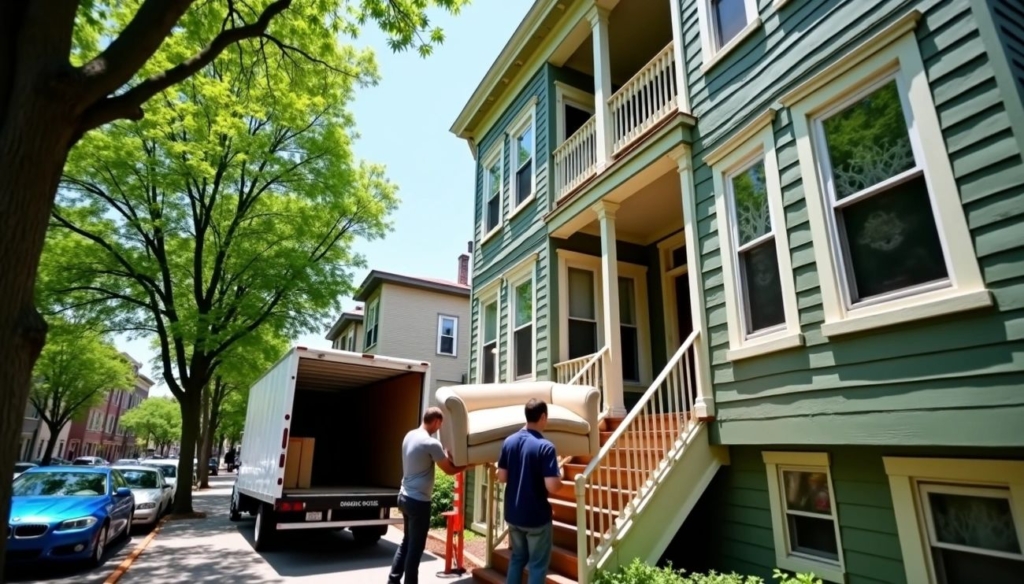
What Is an Allston Triple-Decker and Why Choose One
Boston Triple Decker Basics
A triple decker is a wood-framed, three-story building containing three separate apartments stacked vertically, with one complete unit on each floor. We encounter these structures daily at Lifetime Moving Co. when helping residents relocate throughout the neighborhood. Most boston triple decker buildings were constructed between the late 1800s and early 1900s as housing for working families near factories and streetcar lines.
These buildings share recognizable features: rectangular footprints on narrow city lots, stacked front or rear porches, bay windows on multiple floors and wood clapboard or shingle siding. Triple-deckers comprise 25% of Boston's one-to-three family housing stock. They represent efficient urban design that maximizes living space while maintaining a house-like feel. You'll find them concentrated throughout Allston and Brighton, where our Allston movers handle relocations weekly. The MBTA Green Line's accessibility makes these locations especially attractive for commuters.
Typical Triple Decker House Boston Floor Plan
Each floor follows nearly similar layouts, with units ranging from two to three bedrooms. A typical boston triple decker floor plan has a living room toward the front, a dining room, a kitchen toward the rear and bedrooms clustered off a central hallway. Full bathrooms sit between private and public spaces. Original designs featured hardwood floors and solid woodwork to reduce noise between levels.
Standard dimensions show units around 1,100 to 1,200 square feet per floor. Ceiling heights measure 9 feet commonly and create airy spaces despite the compact footprint. Buildings span about 40 feet wide by 52 feet deep. Most triple decker house designs use a single central staircase serving all three units, though some feature separate entrances for ground-floor occupants. The [Mass.gov Allston Multimodal Project](https://www.mass.gov/) updates affect street access to many of these properties during 2026 construction.
Why Allston Triple-Deckers Appeal to Renters and Buyers
Owner-occupants can live in one unit while renting the other two and gain substantial financial benefits. Rental income offsets mortgage payments, taxes and maintenance costs. Professional movers like us see buyers entering the market to build wealth through this chance. Multi-generational families appreciate keeping extended family members close while maintaining separate living spaces.
Small investors favor the two-to-four unit scale because residential loan programs offer better terms than commercial financing. The spring 2026 market shows strong demand coupled with limited inventory. Moving services in MA are booking quickly as buyers compete for properties near transit and universities. Check Boston.gov for current zoning regulations before purchasing.
Real Success Stories from Allston Triple-Decker Moves
College Students Moving into Shared Units
At Lifetime Moving Co., we help hundreds of students settle into triple decker Boston apartments each September. Researchers at Northeastern University found that millennials are doubling, tripling, and quadrupling up in triple deckers. Student housing data reveal that some 16,685 undergraduates and graduate students live in private housing properties of three units or fewer. Brighton attracts this demographic well. People between ages 25 and 35 account for more than 32 percent of the population.
Parents sometimes purchase condominium units as investments to provide housing while their children attend school and later sell when the student graduates. Our professional movers handle these family-coordinated relocations during the spring 2026 market surge. Check Mass.gov Allston Multimodal Project updates before scheduling September moves.
Young Professionals Who Became Owner-Occupants
Young professionals also recognize the financial advantages of owner-occupancy. We've helped clients who transitioned from renting one floor to purchasing entire buildings. These new owners live in one unit while renting the other two and offset mortgage costs. Lower Allston proves especially attractive. Residents note super safe neighborhoods and most neighbors being young families and young professionals rather than undergrads. MBTA.com shows reliable Green Line access for downtown commuters.
Families Navigating Multi-Floor Layouts
Buildings house single professionals, committed partners and growing families. One resident described their building as "a small, rotating neighborhood under one roof". Moving services in MA like ours help families coordinate moves while respecting other tenants' schedules.
How Previous Movers Handled Narrow Staircases
Movers average 40 moves per day during peak season, compared to six to 12 off-season. Previous residents recommend hiring our Allston movers experienced with tight turns. Contact Boston.gov for parking permits before your move date.
2026 Allston Moving Challenges You Must Know
Cambridge Street Bridge Construction Impact
MassDOT's preservation project on Cambridge Street Bridge restricts westbound traffic to a single lane through October 2026. Lifetime Moving Co. has adapted routes since construction began. This crossing serves as one of only five north-to-south passages over I-90 within a 2-mile stretch. Our Allston movers recommend early morning scheduling to avoid rush hour congestion.
Brighton Avenue Detour Routes
Alternative routes through Brighton Avenue add time during peak construction periods. Check Mass.gov for current detour maps before booking professional movers.
Dealing with Allston Christmas Leftovers
The September 1 moving tradition leaves furniture and debris on sidewalks. Boston issued over 2,500 moving permits for that weekend alone. Spring moves avoid this congestion.
Parking Permit Requirements for Moving Trucks
A standard permit reserves two spaces from 7 a.m. to 5 p.m.. Costs run $69.00 for non-metered spaces or $109.00 with meters. Apply at least two weeks ahead through Boston.gov. You must post signs 48 hours before your move.
Tight Streets and Limited Truck Access
Moving services in MA like ours guide through narrow streets daily. Plan furniture dimensions before moving day.
Timing Your Move Around Construction Schedules
Spring 2026 demand is high. Book Lifetime Moving Co. early and check MBTA.com for transit disruptions affecting your triple decker Boston relocation.
Proven Tips for Moving into a Triple Decker House
Hire Movers Experienced with Boston Triple Decker Buildings
Professional movers familiar with triple decker house layouts save time and prevent damage. Our crews at Lifetime Moving Co. have worked with thousands of Allston buildings where couches go through windows and staircases require 90-degree turns. Hourly rates start at $149.00 for two movers and a truck, with no stair fees. Get three estimates before committing, then book [our Allston movers](https://lifetimemovingco.com/allston-movers/) early for spring 2026 availability.
Pack Smart for Three-Story Moves
Plan for 80-120 boxes depending on belongings. Pack room by room and label each box with contents and destination floor. Professional movers provide packing services that ensure fragile items survive vertical transport. Check Mass.gov for updated moving guidelines.
Protect Staircases and Original Woodwork
Cover stairs with padded runners or non-slip drop cloths before moving day. Wrap railings in moving blankets and secure them with tape. Building paper conforms to stair shapes. Moving services in MA like ours bring protective materials as standard.
Coordinate with Other Tenants in the Building
Notify building management and other residents ahead of time. Establish clear communication channels about elevator access and timing. Reserve service elevators early and confirm arrangements in writing. Visit Boston.gov for tenant coordination resources.
Plan Your Furniture for the Triple Decker Floor Plan
Measure entryways and tight turns beforehand. Disassemble items as much as possible before Lifetime Moving Co. arrives. Remove sofa legs and bed slats to get through narrow stairwells. Contact our Allston movers for spring scheduling.
Conclusion
You now have everything you need to make your Allston triple-decker move successful. Above all, note that spring 2026 demand is higher than ever, so booking experienced movers early makes all the difference. We've helped hundreds of residents handle narrow staircases and construction detours while coordinating with multiple tenants. Our clients who planned ahead avoided stress and settled in smoothly. Your triple-decker move will go smoothly if you prepare now.
Key Takeaways
Moving into an Allston triple-decker requires strategic planning, especially with 2026 construction challenges and high spring demand affecting the market.
• Book experienced movers early - Spring 2026 demand is exceptionally high, and professional movers familiar with triple-decker layouts prevent damage and delays.
• Plan around construction impacts - Cambridge Street Bridge restrictions and Brighton Avenue detours add significant time; schedule moves during off-peak hours.
• Secure parking permits 2+ weeks ahead - Boston requires $69-$109 permits with 48-hour advance posting; late applications cause moving day disasters.
• Measure furniture and disassemble beforehand - Narrow staircases and 90-degree turns require pre-planning; remove sofa legs and bed slats for easier transport.
• Coordinate with building tenants early - Multi-unit buildings need advance notice and clear communication about timing, elevator access, and shared stairway usage.
Triple-deckers offer excellent investment opportunities with rental income offsetting mortgage costs, but success depends on proper preparation and professional execution of your move.
FAQs
Q1. Are apartment buildings quieter than triple-deckers? Not necessarily. While you might assume larger apartment complexes are built with better noise insulation, many newer buildings use thin drywall and cheaper materials that allow sound to travel easily. Noise levels depend more on your specific neighbors and building construction quality than the type of housing. Some luxury apartments even skip concrete layering between floors to cut costs, resulting in more noise than older triple-deckers.
Q2. What are the main advantages of living in a triple-decker versus a large apartment complex? Triple-deckers typically offer more space for your budget, often include outdoor areas, and foster closer relationships with your few neighbors. You'll generally know the other two units personally, making coordination easier. Large complexes offer conveniences like elevators, parking garages, and amenities such as pools, but often charge extra fees for these services and provide less square footage for the same rent.
Q3. How can I reduce noise from upstairs neighbors in a triple-decker? Unfortunately, there's limited soundproofing you can add for ceiling noise. Your best options are moving to a top-floor unit or using white noise machines and noise-canceling earplugs. For side-wall noise, you can install floor-to-ceiling bookcases filled with books or add felt sound panels to absorb sound and create a buffer zone.
Q4. Should I ask about soundproofing when touring apartment buildings? Absolutely. Ask specifically whether there's concrete layered between floors, as this significantly reduces noise transmission. Even luxury apartments sometimes skip this feature to save money. Also inquire about HVAC systems, as shared air returns can carry sounds and smells between units. Request to visit during evening hours to assess actual noise levels.
Q5. Is breaking a lease worth it to escape noisy neighbors? Breaking a lease is a significant financial decision that depends on your lease terms and how severely the noise affects your quality of life. Before breaking your lease, consider speaking with your landlord about the noise issue, documenting problems, or exploring whether your lease has noise violation clauses. Remember that any new living situation carries the risk of encountering noisy neighbors, regardless of building type.