Lexington vs Concord, MA comes up often for buyers who want history, conservation land and a New England town meeting within reach of Boston. The quick answer: Concord has commuter rail service on the Fitchburg Line and an Open Town Meeting, while Lexington has no rail station and relies on MBTA buses to the Red Line at Alewife, but runs a larger public school district with 6,524 students. If Concord is already on your list, our Concord relocation guide covers settling in. Below, we compare how each town governs itself, how you get to Boston, how the schools are organized and what owning an older home involves.
Lexington vs Concord, MA at a Glance
| Lexington | Concord | |
|---|---|---|
| Town Meeting | Representative: 189 elected members, 21 from each of 9 precincts | Open Town Meeting |
| Select Board | 5 members, with a Town Manager | 5 members, with a Town Manager |
| Rail to Boston | No commuter rail station; MBTA buses 62 and 76 to Alewife (Red Line) | Fitchburg Line: Concord and West Concord stations to North Station |
| Public schools (2025–26) | Lexington district: 6,524 students, 10 schools | Concord (PK–8): 1,868 students; Concord-Carlisle (high school): 1,148 students |
| Population (July 1, 2025 estimate) | 34,648 | 18,208 |
| Median value of owner-occupied homes (2020–2024) | $1,203,100 | $1,210,000 |
| Median gross rent (2020–2024) | $2,891 | $2,631 |
| Owner-occupied housing rate (2020–2024) | 80.5% | 75.7% |
| Median household income (2024 dollars) | $238,444 | $195,350 |
Population, housing and income figures come from U.S. Census Bureau QuickFacts for Lexington and Concord; sources for the other rows are linked in the sections below. Median home values are almost identical, so the choice usually comes down to commute, schools and the kind of house you want, not price.
Open vs Representative Town Meeting
Both towns keep the traditional New England setup of a Select Board and Town Manager, but they run Town Meeting differently, and that changes how much of your evening you might spend at it.
Concord describes its government as "an Open Town Meeting and a 5 member Select Board/Town Manager" on its About Concord page. Under an open format, residents who are registered voters take part directly instead of electing representatives.
Lexington uses Representative Town Meeting. The town's 2026 guide to seeking elected office lists a five-member Select Board and a Town Meeting of 189 members, 21 from each of the nine precincts, serving three-year terms. Town Meeting members appear on the ballot at the Annual Town Election, and Town Meeting customarily convenes on the last Monday in March at Cary Memorial Building.
If you want a direct vote on local budgets and bylaws, Concord gives you one. If you would rather elect neighbors to do it, or run for a seat yourself, Lexington's system works that way.
Getting to Boston: Fitchburg Line vs Buses to Alewife
This is the biggest practical difference between the two towns.
Concord has two commuter rail stations. Concord and West Concord are both stops on the MBTA Fitchburg Line, which runs inbound through Lincoln, Waltham and Belmont to North Station. Morning trains from Concord reach North Station in about 46 to 49 minutes on the current timetable, and some trains skip these stops, so check your specific trips. The town also notes that Concord is served by "a commuter bus to Boston."
Lexington has no stop on that line. The town's getting around page says MBTA routes 62 and 76 "connect to the red line train at Alewife," and LexPress buses travel within Lexington. According to the MBTA's fall 2025 bus service changes:
- On weekdays during peak hours, a 62 or 76 bus arrives every 15 to 30 minutes between Alewife and Lexington Center.
- Route 62 runs every day, including Saturday and Sunday, with a weekend bus every 50 minutes.
- Route 76 runs on weekdays only.
Driving. Lexington lists connections to Routes 95/128, Route 2, Routes 4/225 and Route 2A. Concord's town page places it 20 miles west of Boston. Test your commute at rush hour from the exact address before you commit.
Schools: One K–12 District vs a Regional High School
The school setup is different in each town, which matters when you read listings and enrollment data.
- Lexington runs a single district. The DESE profile for Lexington reports 6,524 students across 10 schools in 2025–26.
- Concord splits its schools in two. The Concord district serves pre-kindergarten through grade 8, with 1,868 students in 2025–26 at Alcott, Thoreau, Willard and Concord Middle. High school students attend the regional Concord-Carlisle district, which enrolled 1,148 students at Concord-Carlisle High.
Action steps for families:
- Ask each district which elementary school your address would attend.
- Read the school-level DESE profile, not a third-party ranking.
- Call the registration office for its proof-of-residency list, and line up your lease or closing documents before the move.
Buying an Older Home: Concord's Historic Districts
Concord has six local historic districts under the Concord Historic Districts Act: Barrett Farm, American Mile, North Bridge - Monument Square, Main Street, Hubbardville and Church Street. Inside them, the act requires a certificate before a building is erected or altered, and it also covers exterior color changes visible from a public street, way or place, and signs.
If you plan to add on, replace windows or repaint after you buy, ask whether the house sits in one of these districts before you make an offer. Our guide to buying a historic home in Concord covers inspections and other questions to ask.
History and Open Space: The Battle Road
The two towns share one of the country's best-known stretches of history. Minute Man National Historical Park tells the story of April 19, 1775, the first battle of the Revolution, and includes Concord's North Bridge. The park's Battle Road Trail is a five-mile trail connecting historic sites from Meriam's Corner in Concord to the park's eastern boundary in Lexington.
For new residents, that means a long walking path close to home in either town. If you are house-hunting near the park, walk a section of the trail from the address you are considering.
Moving Day in a Historic Suburb
Older homes, long driveways and winter weather all affect a Lexington or Concord move.
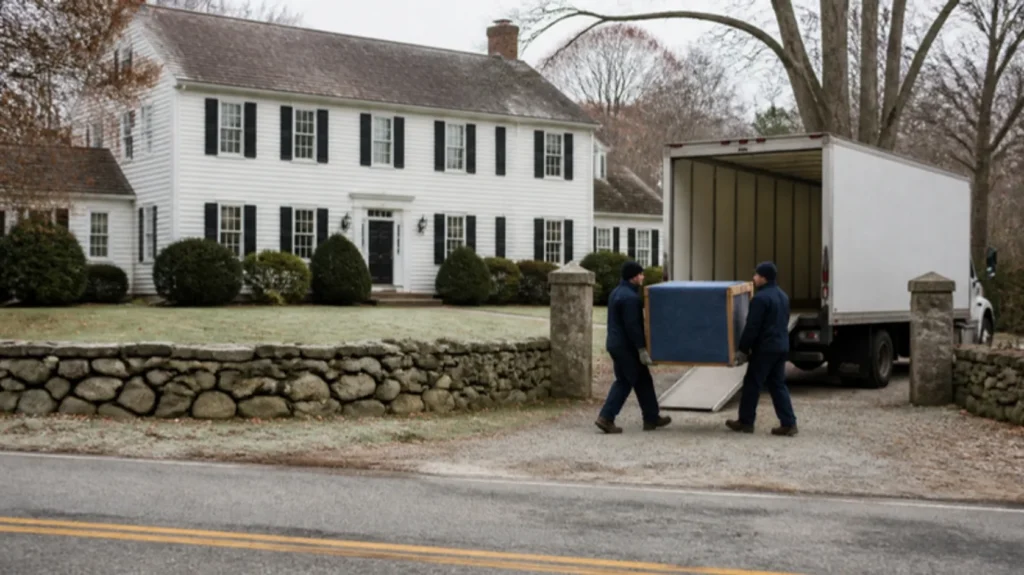
- Check the driveway and approach. Gravel driveways, stone walls and narrow country roads can limit where a truck parks. Walk the route with your mover or send photos ahead.
- Crate the irreplaceable. Antiques, framed art and glass tabletops travel better in a crate than in a box. Lifetime Moving Co builds custom crates for fragile and high-value pieces.
- Set up the right electric company. Concord's town page says the Concord Municipal Light Plant distributes electricity in town, so you start service with the town, not a private utility.
- Plan for frost and snow. From November on, keep a backup date and clear and salt walkways before the crew arrives.
- Measure older doorways and stairs. Antique homes often have narrow, steep stairways. Our residential moving crews disassemble and reassemble furniture to get large pieces through tight spaces.
Our office on Union Avenue in Sudbury is a short drive from both towns, and we are open Monday through Sunday, 7 AM to 6 PM.
Lexington or Concord: Who Each One Suits
Lexington may suit you if:
- You want a larger K–12 district in one system
- You commute toward Cambridge or the Red Line and are fine with a bus to Alewife
- You like electing Town Meeting members by precinct
Concord may suit you if:
- You want a commuter rail station to North Station
- You want a direct vote at Open Town Meeting
- You are drawn to homes in a local historic district and are ready for the review process
Comparing more towns west of Boston? Read Sudbury vs Wayland or our list of Massachusetts towns for families.
Key Takeaways
- Concord has Fitchburg Line stations at Concord and West Concord; Lexington relies on MBTA buses 62 and 76 to Alewife.
- Concord holds an Open Town Meeting; Lexington elects 189 Town Meeting members across nine precincts.
- Lexington's single district enrolled 6,524 students in 2025–26; Concord students attend the Concord district through grade 8 and Concord-Carlisle High after that.
- Median home values are nearly the same (about $1.2 million in both towns), per the Census Bureau.
- Concord has six local historic districts where exterior changes need approval.
- The Battle Road Trail connects the two towns through Minute Man National Historical Park.
Frequently Asked Questions
Is there a train from Lexington MA to Boston?
Lexington has no commuter rail station. The town points riders to MBTA buses 62 and 76, which connect to the Red Line at Alewife. Concord, by contrast, has two Fitchburg Line stations.
How far is Concord MA from Boston?
The Town of Concord says it is 20 miles west of Boston. Trains from Concord and West Concord run to North Station.
Does Concord MA have its own high school?
Concord students in grades 9 to 12 attend Concord-Carlisle High, part of the regional Concord-Carlisle district. The Concord district itself serves pre-kindergarten through grade 8.
Is Lexington MA town meeting open to everyone?
No. Lexington has a Representative Town Meeting of 189 members elected by precinct. Concord holds an Open Town Meeting instead.
Are homes cheaper in Lexington or Concord?
They are close. Census Bureau QuickFacts puts the median value of owner-occupied homes at $1,203,100 in Lexington and $1,210,000 in Concord (2020–2024). Median gross rent is higher in Lexington, at $2,891 versus $2,631. For a moving quote from either town, contact the Lifetime Moving Co team.
Ready to move to Lexington or Concord? Lifetime Moving Co is fully insured and family-owned, with offices in Sudbury, Brighton and Southborough. Get your free moving quote or call (508) 630-4292.