Moving to Southborough, MA from a city apartment to a luxury townhouse means trading vertical living for vertical logistics.
Your move from an apartment to a house changes more than just your address. It changes how you live day to day. You're dealing with multiple floors and by a lot more square footage suddenly. Your upsizing home move can quickly turn chaotic without a plan for packing to move.
What works? Start early and have a plan. We'll walk you through how to pack a home for moving across multiple levels in this piece. You'll learn floor-by-floor labeling systems and townhouse moving logistics that professional movers use. We'll also share our complete moving from apartment to house checklist so nothing gets lost in the shuffle.
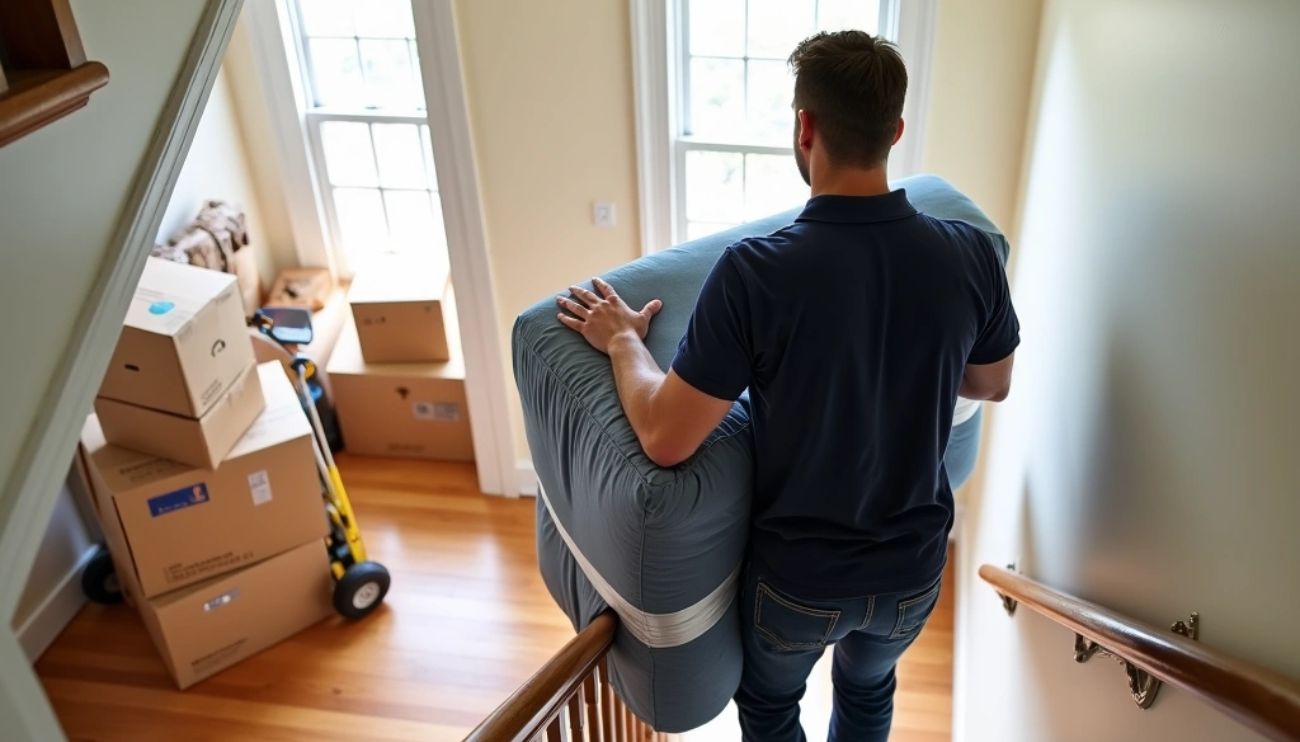
Understanding the Vertical Challenge: Townhouse Layout vs. Apartment
Townhouses operate on a different spatial logic than apartments. Apartments spread horizontally across a single floor. Townhouses in Southborough stack vertically across multiple levels, with living areas and kitchens on the first floor and bedrooms on the second. This vertical arrangement creates what we call Vertical Carrying Logistics. Every piece of furniture must move upward or downward through confined passages.
Multi-Flight Stairways and Narrow Entries
Understanding stairway architecture is where the physical reality of townhouse moving logistics starts. Straight staircases present the least complications since you won't need to rotate furniture mid-climb. Helical or spiral staircases introduce extreme difficulty and danger. They're narrow without landings and require constant twisting. Some staircases in older properties measure as narrow as 28 to 30 inches wide. This makes standard furniture transport almost impossible.
Standard doorways measure 30 to 36 inches wide, but older homes may feature narrower openings. The height threshold matters for moving furniture vertically. Items under 6.5 feet high should be positioned vertically with a slight tilt for stability. This allows easier turns on landings. Taller pieces like wardrobes or sectional sofas must move horizontally to avoid catching against staircase ceilings.
Hoisting Restrictions and Access Points
Hoisting becomes the solution for stairways that won't accommodate oversized items. This involves lifting furniture through windows, balconies, or other openings using secure ropes, pulleys, and lifting harnesses. Professional movers Southborough teams assess whether hoisting is necessary during original estimates. However, local regulations or building rules may require permits for hoisting operations.
Measuring Doorways and Stairwell Clearances
Precise measurements prevent disaster. Measure ceiling height from both the bottom step and top step, as these determine vertical clearance. The diagonal measurement from stair treads to the landing above tells you what tilting angles are possible. Leave an extra 1 to 2 inches of clearance to avoid tight squeezes when comparing measurements. Measure inside the doorframe, as the actual opening may be smaller than expected. Account for handrails and banisters when calculating usable width. Document everything with photos for your moving team.
Strategic Floor-by-Floor Labeling for Multi-Story Moves
Boxes labeled by room name alone create confusion when those rooms span three different floors. A townhouse "bedroom" could mean the master suite on the second floor, guest room on the third, or basement bedroom. Movers waste time asking questions, and boxes end up on the wrong level. You'll haul items up or down stairs later.
Why Traditional Room Labels Fail in Townhouses
Single-floor apartments allow simple room designations. Townhouses just need floor identification first. "MBR" for Master Bedroom means nothing if your movers don't know which level houses the master suite. Abbreviations like "B" create problems, as it could mean bedroom, bathroom, or basement. Traditional labeling assumes horizontal navigation, not vertical.
Creating a Floor-Specific Labeling System
Floor-specific labels combine level designation with room acronyms. Write memorable acronyms in capital letters with black Sharpie on large white labels. The format "Floor 2 - MBR" or "Basement - Storage" removes ambiguity. Before moving day, walk your moving team through each floor and review your naming scheme. Post large yellow sticky notes on door frames that identify each room using your chosen acronyms.
Color-Coding by Level for Movers
Assign distinct colors to each floor rather than individual rooms. Red for the main floor, blue for the second floor, yellow for the basement makes visual identification simple. Color-coded systems remove language barriers and illegible handwriting issues. Label the top and at least two sides of every box to ensure visibility when stacked. Post color-coded keys at all entry points and stairwells so movers work without constant direction.
Sample Labels: Basement, Main Level, and Upper Floors
Basement: "Red - Basement Storage" or "Red - Basement Bedroom"
Main Level: "Blue - Main Kitchen" or "Blue - Main Living"
Upper Floors: "Yellow - Floor 2 MBR" or "Yellow - Floor 3 Guest"
Number boxes within each room to track totals.
How to Pack for a Townhouse: Space and Layout Considerations
Upsizing from a compact apartment introduces what we call Volume Escalation, where you're not just moving more stuff but distributing it through distinct vertical zones. Each packing decision affects how items travel through your townhouse on move-in day efficiently.
Decluttering Before Upsizing
Assess what deserves the move before you pack a single box. Start with one room at a time and sort belongings into four categories: keep, donate, sell, and toss. Moving costs more when you have more items, given that every box adds time and labor. Start decluttering 1-3 months before your move. Handle easy decisions first. Eliminate expired foods, old utility bills, or stained clothing rather than sentimental items. Skip the "maybe" pile. These always become the largest pile and delay hard decisions. Think about whether your current furniture fits the new floor plan if you're moving to Southborough's townhouse communities[134].
Packing by Future Room Placement
Pack one room at a time. Start with least-used spaces like guest rooms or storage areas. This room-by-room strategy keeps boxes organized and reduces stress. Pack similar items together based on their destination in your new townhouse. Heavy items like books belong in small boxes, while lighter items like bedding fit large boxes. Fill boxes without overfilling to prevent crushing when stacked.
Protecting Items for Multi-Flight Transport
Multi-Level Staging requires extra protection. Wrap dishes in bubble wrap or packing paper, then stack plates vertically like records. Cushion boxes with towels or clothing for padding. Never pack boxes heavier than 50 pounds to ensure safe carrying up stairs.
Essential Packing Supplies for Townhouse Moves
Stock up on small, medium, and large boxes, plus specialty wardrobe boxes. You'll need packing tape, bubble wrap, packing paper, permanent markers, and labels. Professional movers Southborough teams from Lifetime Moving Co. can supply quality materials designed for multi-story moves.
Unpacking Systematically Across Multiple Floors
The unpacking sequence determines whether you settle into living in Southborough comfortably or spend weeks hauling items between floors.
Prioritizing High-Traffic Areas First
Start with bathroom essentials for hygiene routines and then move to the bedroom to get comfortable sleep. Your bed frame with fresh linens provides normalcy after exhausting move-in days. The kitchen follows next, as functional cooking space eliminates chaos. Dishes, utensils and cookware need unpacking to enable meal preparation instead of endless takeout.
Setting Up Your Main Suite and Living Spaces
Bedroom furniture needs assembly and clothes should go in closets by type and how often you use them. Nightstands and lamps get positioned next, and personal items arranged to create your sanctuary. The living room comes after that, with major furniture pieces like couches and entertainment systems arranged to create your gathering space. Floor lamps and table lamps improve ambiance through proper lighting.
Managing Basement and Storage Zones Last
Utility rooms and basements contain non-essential items and become final priorities. These spaces need organization before unpacking boxes to improve efficiency.
Avoiding the Cross-Floor Shuffle Weeks Later
One floor at a time works better than opening boxes across levels at random. This prevents the exhausting pattern of discovering misplaced items weeks later and carrying them up or down multiple flights.
Conclusion
Moving to Southborough MA changes your living experience, and in fact, proper planning is what matters most. When you follow our floor-specific labeling system, protect items for Multi-Level Staging and unpack strategically, your upsizing home move becomes manageable instead of overwhelming.
You're trading your cramped city flat for a spacious multi-level townhouse in Southborough? The stairs shouldn't overwhelm you. Get a free quote from Lifetime Moving Co. today and let our heavy-lifting experts execute a flawless multi-story move!
Key Takeaways
Moving from a city apartment to a multi-story townhouse requires a fundamentally different approach than traditional single-floor moves. Success depends on understanding vertical logistics and implementing strategic systems.
• Measure everything before moving day: Stairwell widths, doorway clearances, and ceiling heights determine what furniture can navigate multiple floors—items under 6.5 feet move vertically, taller pieces require horizontal positioning.
• Implement floor-specific labeling with color codes: Traditional room labels fail in townhouses; use "Floor 2 - MBR" format combined with color-coding (red for main, blue for second floor) to eliminate confusion and prevent cross-floor shuffling.
• Declutter 1-3 months before moving: Upsizing doesn't mean keeping everything—every box adds moving costs and complexity, so eliminate unnecessary items before packing to reduce volume and stress.
• Pack by future room placement, not current location: Use small boxes for heavy items like books, protect fragile items with extra padding for multi-flight transport, and never exceed 50 pounds per box for safe stair navigation.
• Unpack high-traffic areas first: Start with bathrooms and bedrooms for immediate comfort, then kitchen for functionality, saving basements and storage zones for last to avoid living in chaos for weeks.
The vertical challenge of townhouse living demands professional expertise. Proper planning, strategic labeling systems, and systematic unpacking transform what could be an overwhelming multi-story move into a manageable transition to your Southborough luxury townhouse.
FAQs
Q1. What are the main challenges when moving furniture into a multi-story townhouse? The biggest challenge is navigating narrow staircases and doorways. Standard doorways are typically 30-36 inches wide, but older homes may have narrower openings. Straight staircases are easiest to work with, while spiral staircases create extreme difficulty due to their narrow width and constant twisting requirements. Items under 6.5 feet should be positioned vertically with a slight tilt, while taller pieces like wardrobes need to move horizontally to avoid catching on staircase ceilings.
Q2. How should I label boxes when moving to a townhouse with multiple floors? Use a floor-specific labeling system that combines level designation with room names, such as "Floor 2 - MBR" or "Basement - Storage." Color-coding each floor makes it even easier—assign red for the main floor, blue for the second floor, and yellow for the basement. Label the top and at least two sides of every box, and post color-coded keys at entry points so movers can work independently without constant direction.
Q3. When should I start decluttering before moving to a larger home? Begin decluttering 1-3 months before your move. Even though you're upsizing, moving costs increase with every additional box, so eliminate unnecessary items early. Start with one room at a time, sorting belongings into keep, donate, sell, and toss categories. Handle easy decisions first—expired foods, old bills, stained clothing—rather than starting with sentimental items.
Q4. What's the best strategy for unpacking in a multi-story townhouse? Prioritize high-traffic areas first: start with bathrooms for hygiene routines, then bedrooms to establish sleep comfort, followed by the kitchen for meal preparation. Set up your bed with fresh linens and unpack essential cookware before tackling other areas. Save basements and storage zones for last since they contain non-essential items. Unpack one floor at a time systematically to avoid the exhausting pattern of carrying misplaced items between floors weeks later.
Q5. What packing supplies are essential for a townhouse move? Stock up on small, medium, and large boxes in various sizes, plus specialty wardrobe boxes for hanging clothes. You'll need quality packing tape, bubble wrap, packing paper, permanent markers, and color-coded labels. Use small boxes for heavy items like books and large boxes for lighter items like bedding. Never pack boxes heavier than 50 pounds to ensure safe carrying up multiple flights of stairs, and fill boxes completely without overfilling to prevent crushing when stacked.