Planning a move in Boston and wondering if you need a moving truck permit boston? The answer is definitely yes. Skip it and things will get pricey.
You're risking parking tickets starting at $40 to $90 without a proper boston moving permit. Towing fees run over $100, and you'll face hours of delays on moving day. Dense neighborhoods like Back Bay and the South End make finding legal moving truck parking Boston nearly impossible without a temporary parking permit boston. The standard permit costs around $69, with additional fees for metered spaces.
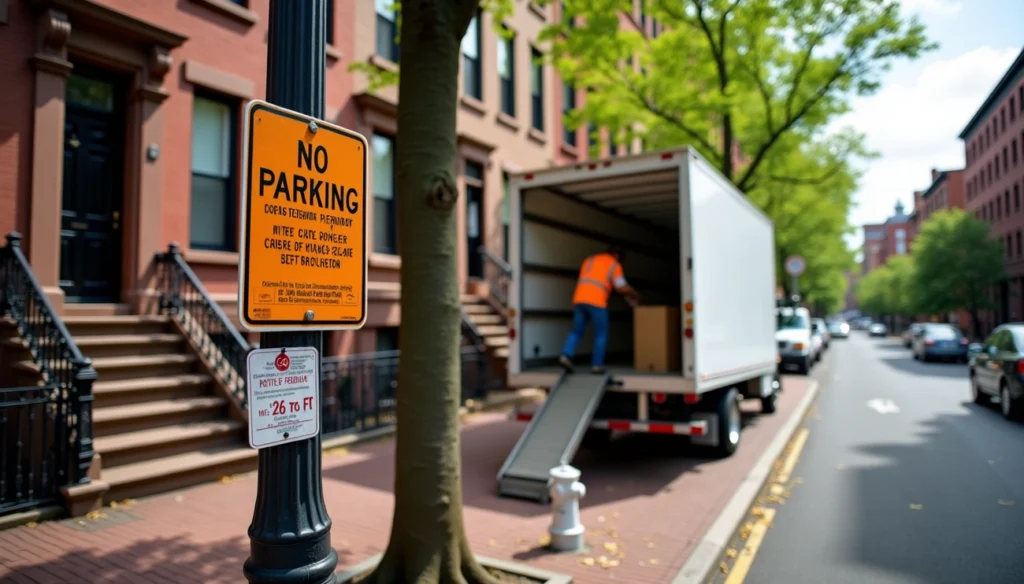
Here's everything you need to know: 2026 fees, the 48-hour sign posting rule, application steps, and how to avoid expensive violations.
The Real Cost of Skipping a Moving Permit in Boston
Boston Parking Enforcement monitors moving activity throughout the city during business hours, with particular attention during peak moving months of May, June, and September. Moving without a permit exposes you to a cascade of costs well beyond the permit fee.
Parking Tickets and Towing Fees
An unpermitted moving truck faces violations right away. Parking in a resident permit zone without authorization triggers a $40 ticket, while double-parking carries a $55 fine. Blocking a fire hydrant escalates the penalty to $100.
Towing transforms a minor oversight into a major financial burden. Police-ordered towing for a moving truck costs $132 for the original tow, plus $35 per 24-hour period for storage. The total climbs to $200 to $350 if you cannot retrieve your truck on the same day. The tow lot at 200 Frontage Road operates Monday through Friday, 7 a.m. to 10:30 p.m. Weekend moves face additional delays and storage charges.
Delays That Cost You Money
Professional movers charging $80 to $150 per hour for a three-person crew cannot work when circling blocks or managing parking enforcement. An unpermitted truck creates 30 to 90 minutes of repositioning delays. At standard labor rates, those delays add $40 to $225 in extra moving costs. A $69 permit prevents this whole expense.
Your movers might spend more time waiting than working due to parking conflicts. The crew stops unloading to handle the situation if enforcement arrives mid-move, extending your hourly charges while accomplishing nothing.
Neighbor Complaints and Legal Issues
A moving truck blocking driveways or obstructing neighbor vehicles without proper authorization creates friction right away. Building management receives formal complaints that can affect your tenancy from day one. The permit functions as proof of courtesy and signals you followed proper procedures and respected shared street space.
Boston Moving Permit Fees and Types (2026)
City regulations require specific documentation for street parking during relocations, with fees structured around location and duration. Understanding the fee breakdown prevents application errors that delay approval.
Standard Moving Truck Permit Cost
The base rate for a boston moving permit sits at $69.00 for one day covering two non-metered parking spaces. This has everything needed for standard residential moves in neighborhoods like Allston, Brighton, and Jamaica Plain. The fee breakdown works as follows: a $50.00 application processing charge, a $11.00 space calculation fee (based on $1.00 per square foot per month for a standard 40-foot by 8-foot zone, prorated to one day), and $8.00 for two official "No Parking" signs at $4.00 each.
Applications submitted fewer than three business days before your move trigger a $20.00 late surcharge. This brings the total to $89.00. Multi-day reservations run $130.00 to $140.00 for two consecutive days on non-metered streets[91].
Boston Street Occupancy Permit
The city issues temporary moving truck permits through the Parking Clerk's Office, covering box trucks and commercial moving vans. Standard permits reserve about 40 linear feet (two parking spaces) from 7:00 a.m. to 5:00 p.m. by default. Container permits for PODS or similar storage units require in-person applications whatever the advance notice, as opposed to truck permits which accept online submissions.
Additional Fees for Metered Spaces
Metered locations in Back Bay, Downtown, Seaport, and South End require an extra $40.00 surcharge per day for two spaces. Because of lost meter revenue, the city charges $20.00 per metered space per day. A standard two-space permit on a metered street costs $109.00 to $110.00 total[91].
No Parking Signs Fee
Each official sign costs $4.00, with two signs included in the standard permit. Signs must meet city specifications to authorize towing of unauthorized vehicles from your reserved zone.
Payment accepts Visa, MasterCard, Discover, American Express, or pinless debit cards. Credit and debit transactions carry a non-refundable 2.5% processing fee with a $1.00 minimum paid to the card processor. Personal checks are no longer accepted for moving truck permits, effective February 10, 2020.
Step-by-Step: How to Apply for Your Boston Moving Truck Permit
Your moving permit boston ma follows a timeline-dependent process based on when you need the permit.
Two Weeks Before: Check Your Street and Gather Information
You should begin your application at least two weeks before your move date to avoid processing delays. Search the City of Boston Street Occupancy Permit database to verify your chosen parking location remains available on your target date. Confirm the address and identify whether metered parking exists at that location. Note any utility pole or meter-head numbers you'll reference during application.
One Week Before: Submit Your Online Application
Online applications require your move date to fall between 15 days and eight weeks away. Visit boston.gov/moving to submit your request for standard one-day, two-space permits. The system mails approved permits to your registered address, so allow 7 to 10 days for delivery to ensure materials arrive before your move.
Three Days Before: Visit City Hall Room 721 for In-Person Filing
Moves scheduled fewer than 15 days out require in-person filing at the Transportation Department, Room 721 at Boston City Hall. The office operates during business hours, 9:00 a.m. to 5:00 p.m., Monday through Friday. Wait times run 15 minutes but can exceed one hour during summer months when moving activity peaks. You receive your permit and signs upon payment approval.
What Information You'll Need to Provide
Applications require your move date, the exact street address where the truck will park, and vehicle type and size. Bring meter-head identification numbers if applicable.
The 48-Hour Sign Posting Rule (And How to Do It Right)
Proper sign placement determines whether Boston enforces your reserved space on moving day. Post official "No Parking" signs at least 48 hours before your 7 a.m. permit start time for non-metered spaces. Metered locations require signs posted 24 hours in advance. So if your move starts Saturday at 7 a.m., post signs by Thursday at 7 a.m. for non-metered spots or Friday at 7 a.m. for metered areas.
Where to Place Your No Parking Signs
Attach signs to utility poles or parking meters at both ends of your reserved zone and at regular intervals. Fire hydrants, crosswalks, and areas within 10 feet of driveways are off-limits for sign placement. Position signs at eye level for maximum visibility to drivers.
How to Secure Signs on Trees, Posts, or Fences
Use zip ties or strong tape to prevent wind or rain from removing them. Rope or string works on trees and street sign poles. Tape on bare poles may not hold securely.
What to Do If Someone Parks in Your Reserved Space
Call 911 if a vehicle occupies your permitted space. State "this is not an emergency" right away to avoid tying up emergency resources[191]. Boston requires police authorization before towing. Officers run the plate and attempt to contact the owner for voluntary removal. This process takes two hours or longer[191].
Taking Photos for Proof of Posting
Photograph your posted signs right after installation[161]. Timestamped photos prove compliance if you need to call parking enforcement on move day.
Conclusion
Right now, you have everything you need to secure legal moving truck parking Boston without risking $90+ violations or towing fees. The $69 permit saves you hundreds in delays and enforcement costs when you follow the 48-hour posting rule correctly.
Start your application at least two weeks out to avoid the $20 late fee and delivery delays. Take the case of metered spaces: budget an extra $40 per day and post signs 24 hours ahead.
Follow these steps, and your move will go smoothly without expensive surprises.
Key Takeaways
Moving in Boston without a permit can cost you significantly more than the permit itself, making advance planning essential for a smooth relocation.
• Apply early to save money: Submit your Boston moving permit application at least two weeks before your move date to avoid the $20 late fee and secure the standard $69 rate.
• Budget for location-specific costs: Metered spaces in areas like Back Bay and Downtown require an additional $40 surcharge, bringing total costs to around $109-110.
• Follow the 48-hour posting rule: Post official "No Parking" signs 48 hours before your move (24 hours for metered spaces) to ensure enforcement protection on moving day.
• Skipping permits costs more than getting them: Unpermitted moves risk $40-100 parking tickets, $132+ towing fees, and $40-225 in moving crew delays—far exceeding the permit cost.
• Use online applications for advance planning: Apply online at boston.gov/moving for moves 15 days to 8 weeks away, or visit City Hall Room 721 for last-minute applications.
The $69 investment in a proper permit protects you from hundreds of dollars in violations, delays, and neighbor complaints while ensuring your moving truck has guaranteed legal parking space.
FAQs
Q1. How do I apply for a moving truck permit in Boston? You can apply online at boston.gov/moving if your move is between 15 days and 8 weeks away. For moves scheduled within 15 days, you must visit City Hall Room 721 in person during business hours (9 a.m. to 5 p.m., Monday through Friday). Online applications typically take 7-10 days for delivery, while in-person applications provide immediate permit and sign pickup.
Q2. How much does a Boston moving permit cost in 2026? The standard moving permit costs $69 for one day covering two non-metered parking spaces. This includes a $50 application fee, $11 space calculation fee, and $8 for two official "No Parking" signs. Metered locations require an additional $40 surcharge, bringing the total to approximately $109-110. Late applications (fewer than three business days before your move) incur a $20 surcharge.
Q3. What happens if I don't get a moving permit in Boston? Moving without a permit can result in parking tickets ranging from $40 to $100, towing fees starting at $132 plus $35 per day storage, and moving crew delays costing $40-225 in additional labor charges. You also risk neighbor complaints and potential legal issues with building management.
Q4. What is the 48-hour sign posting rule for Boston moving permits? You must post official "No Parking" signs at least 48 hours before your move start time for non-metered spaces, or 24 hours in advance for metered locations. Signs should be placed at both ends of your reserved zone at eye level using zip ties or strong tape on utility poles or parking meters.
Q5. What should I do if someone parks in my reserved moving space? Call 911 and immediately state "this is not an emergency." Boston requires police authorization before towing can occur. Officers will run the vehicle's plate and attempt to contact the owner for voluntary removal, though this process can take two hours or longer. Having timestamped photos of your properly posted signs helps prove compliance.