Medford MA apartment moving looks drastically different depending on whether you're heading to a century-old walk-up or a modern high-rise. Medford sits six miles northwest of Boston and offers renters two distinct worlds: historic triple-deckers in Medford Square ma with narrow staircases and limited parking, or sleek Station Landing apartments with freight elevators and strict building management protocols. The rental market remains competitive. Average rents hit $2,987, making it more affordable than neighboring Boston while offering a variety of housing options. Medford's architectural variety means your moving strategy must match your building type, which sets it apart from many cities with uniform apartment stock. You need to know how to navigate both scenarios, whether that means measuring furniture against 30-inch stairwells or coordinating loading dock reservations.
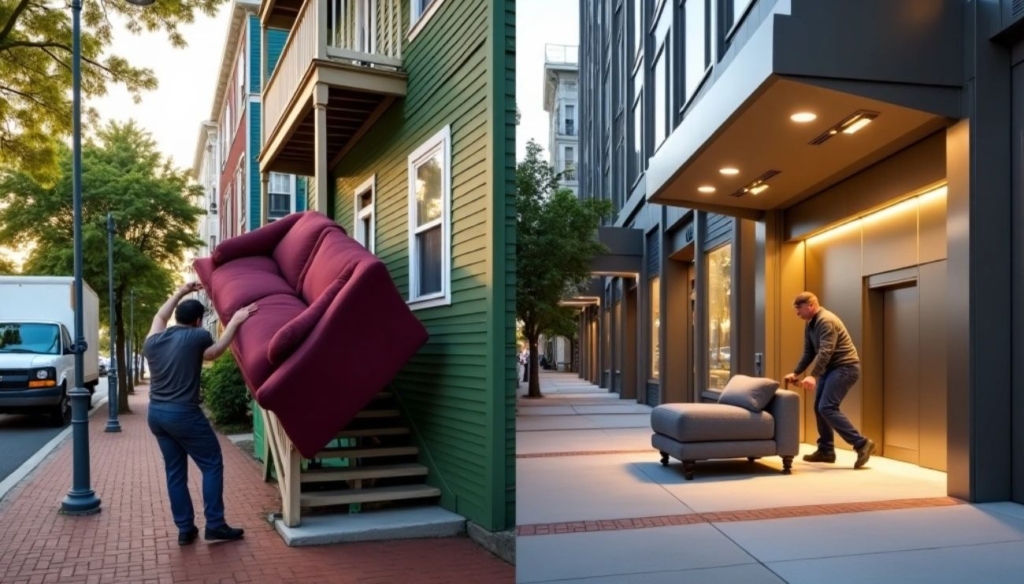
Understanding Medford's Two Housing Worlds: Historic Multi-Family vs Modern Complexes
Medford Square's Century-Old Triple-Deckers and Walk-Ups
Triple-deckers dominate the Medford Square ma residential landscape. These freestanding wooden structures rose between the late 1800s and World War I. They were built to house working-class and immigrant families flooding into New England's industrial centers. The design follows a simple formula: narrow and deep proportions fitted to urban lots, three similar apartments stacked vertically and accessed through common front and rear stairwells. Most feature wood frame construction using balloon framing methods, though you'll find some built with brick or concrete block. The buildings accommodate extended families across multiple units. Many remain owner-occupied on the first floor.
Station Landing's High-Rise Luxury Buildings
Station Landing apartments represent the opposite end of Medford's housing spectrum. Phase I delivered 292 units across two six-story buildings in 2006. The development features 67,000 square feet of ground-floor retail space and underground parking. The complex earned LEED Gold Certification and sits adjacent to Wellington MBTA station via an overhead skywalk. Units come standard with granite countertops, stainless steel appliances, in-suite washers and dryers, and HVAC systems that residents control individually. Building amenities include a 50,000-square-foot Life Time Athletic Club onsite, 24-hour maintenance, and package concierge systems. The whole development spans 16.32 acres and follows New Urbanism design principles.
Why Your Building Type Determines Your Moving Strategy
Physical architecture dictates your Medford MA apartment moving approach. Triple-deckers lack elevators. This forces furniture through narrow stairwells built for households of the 1900s era. Station Landing's service elevators and loading docks require coordination with property management rather than navigating tight corners. Building age affects everything from doorway widths to parking access.
Moving Into Historic Medford Square Apartments: Navigating Narrow Stairs and Limited Access
Measuring Your Furniture Against 30-Inch Stairwells
Residential staircases must be at least 36 inches wide. Medford Square ma triple-deckers often meet this bare minimum and leave little clearance once you account for railings and wall protrusions. Measure your furniture's height, width, and depth before moving day. Handles, decorative elements, and any parts that stick out should be included. Write these numbers down instead of relying on memory.
Measure doorways at their narrowest point and calculate diagonal clearances for items like couches and mattresses. A three-seat sofa might fit lengthwise but fail at the time it's tilted vertically around corners. Professional Medford MA apartment moving teams check which orientation provides the most clearance and test vertical versus horizontal positioning before committing to a path.
Managing Tight Landings and Transom Heights
Building codes require 6 feet 8 inches of vertical clearance between stair treads and ceiling. Older Medford Square apartments sometimes cut closer to this minimum. Light fixtures, railings, and sharp turns create additional obstacles if you don't plan around them.
Landings must match the staircase's width with a minimum 36-inch depth. Pivot your furniture in small increments at the time space gets tight. Move forward a few inches, rotate slightly, then advance again.
Street Parking Challenges in Residential Neighborhoods
Residential permit zones and metered streets dominate Medford Square. Temporary No Parking permits require posting signs at least 48 hours in advance. Fees run $25 to $50 per day. Scout your block at the same time of day as your scheduled move to identify parking patterns.
Why Professional Movers Use Specialized Equipment for Walk-Ups
Furniture sliders, shoulder straps, and dollies redistribute weight in cramped spaces. Door jamb protectors and corner guards prevent wall damage during tight turns. Station Landing apartment move coordination is different, but walk-ups just need these specific tools for safe transport.
Timeline: Expect 6-8 Hours for a Two-Bedroom Walk-Up Move
Each floor above ground level adds 30 to 60 minutes to your total move time. A two-bedroom apartment on the third floor takes 3 to 6 hours with a three-mover crew. Narrow hallways and tight doorways can add another 30 to 60 minutes for maneuvering large items.
Moving Into Station Landing Apartments: Building Management Rules and High-Rise Logistics
Station Landing apartments operate under strict building management protocols that replace physical obstacles with administrative requirements. Your moving company must handle paperwork and scheduling rather than narrow stairwells.
Certificate of Insurance (COI) Requirements and Submission Deadlines
Buildings need a Certificate of Insurance naming them as additional insured before granting access. The COI verifies general liability, workers' compensation, and automobile coverage. Submit this document at least 48 hours before your scheduled move date. Movers get denied entry without proper documentation, whatever your reservation.
Reserving Freight Elevators and Loading Dock Time Slots
Contact property management 2 to 4 weeks in advance to secure elevator access. High-demand periods like month-end need earlier booking. Confirm both the freight elevator and loading dock availability, as some buildings tie these reservations together.
Understanding Move-In Windows and Restricted Hours
Most managed buildings limit moves to weekdays between 9 AM and 5 PM. Weekend moves often need special approval and additional fees. Your reserved window runs 4 hours maximum.
Building-Specific Equipment: What Fits in Service Elevators
Service elevator cabs measure 60 to 80 inches wide and 80 to 101 inches deep with door openings of 48 to 54 inches. Weight capacity ranges from 2,500 to 4,500 pounds.
Timeline: Coordinating Your 4-Hour Reserved Move Window
Plan to complete your Station Landing apartment move within the assigned block. Late arrivals consume your reserved time without extension.
Side-by-Side Comparison: What to Expect When Moving to Each Location
Equipment needs change dramatically between location types. Walk-ups just need utility dollies with pneumatic wheels for stair navigation and furniture lifting straps that distribute weight across shoulders. Station Landing apartment move crews rely on four-wheel furniture dollies with carpeted platforms and protective furniture pads to prevent damage to the elevator's interior.
Equipment Needed: Dollies vs Furniture Pads and Hoisting Straps
Two-wheel hand trucks handle Medford Square ma staircases and support 500-600 pounds with shock-absorbing wheels. High-rise moves need flat furniture dollies with 1,000-pound capacity and tight turning radius for hallways.
Permit Requirements: Residential Streets vs Private Property Rules
Temporary No Parking permits cost $25-50 per 40 feet of space on residential streets. You must post them 48 hours in advance. Station Landing apartments demand Certificate of Insurance from movers instead and name the building as additional insured.
Cost Differences: Walk-Up Labor Rates vs High-Rise Coordination Fees
Labor-only Medford MA apartment moving runs $50 per hour per mover. Managed buildings charge $135-225 per hour with 3-hour minimums plus travel time.
Furniture Restrictions: What Won't Fit Through Historic Doorways vs Modern Elevators
Pre-1950s apartments have 26-28 inch doors with 24.5-inch clear openings. This eliminates queen mattresses and standard couches. Service elevators accommodate 48-54 inch door openings with 2,500-4,500 pound weight limits.
Parking Access: On-Street Meters vs Designated Loading Zones
Medford Square requires street meter feeding or permit zones. Station Landing provides designated loading docks with reserved time slots.
Comparison Table
Medford MA Apartment Moving: Comparison Table
| Feature | Medford Square (Historic Walk-Ups) | Station Landing (Modern High-Rise) |
|---|---|---|
| Building Type | Century-old triple-deckers, wood frame construction (late 1800s - WWI era) | Modern 6-story luxury buildings (2006), LEED Gold Certified |
| Elevator Access | No elevators | Freight/service elevators available |
| Stairwell Width | 36 inches minimum (often bare minimum) | N/A (elevator access) |
| Doorway Width | 26-28 inches (24.5-inch clear opening for pre-1950s units) | 48-54 inches (service elevator door openings) |
| Vertical Clearance | 6 feet 8 inches minimum (sometimes closer to minimum) | 60-80 inches wide, 80-101 inches deep elevator cabs |
| Weight Capacity | N/A | 2,500-4,500 pounds (service elevator) |
| Equipment Needed | Utility dollies with pneumatic wheels, furniture lifting straps, two-wheel hand trucks (500-600 lb capacity), furniture sliders, shoulder straps | Four-wheel furniture dollies with carpeted platforms (1,000 lb capacity), protective furniture pads |
| Permit Requirements | Temporary No Parking permits ($25-50 per day, 48-hour advance posting required) | Certificate of Insurance (COI) naming building as additional insured |
| Insurance Documentation | None required | Required 48 hours before move date (general liability, workers' comp, auto coverage) |
| Advance Booking | 48 hours for parking permits | 2-4 weeks for elevator/loading dock reservation |
| Move-In Hours | Not restricted | Weekdays 9 AM - 5 PM (weekends require special approval and additional fees) |
| Time Window | No specific window | 4-hour maximum reserved window |
| Parking Access | On-street meters or residential permit zones | Designated loading docks with reserved time slots |
| Cost Structure | $50 per hour per mover (labor-only) | $135-225 per hour with 3-hour minimums plus travel time |
| Timeline (2-Bedroom) | 6-8 hours total (3-6 hours with 3-mover crew, plus 30-60 minutes per floor above ground) | Must complete within 4-hour reserved window |
| Additional Time Factors | Each floor adds 30-60 minutes; narrow hallways add 30-60 minutes | Late arrivals consume reserved time without extension |
| Furniture Restrictions | Queen mattresses and standard couches may not fit through 24.5-inch doorways | 48-54 inch elevator door openings accommodate larger items |
| Building Amenities | Owner-occupied units, common stairwells | 24-hour maintenance, package concierge, communal workspaces, onsite fitness club |
Conclusion
Your Medford MA apartment moving strategy hinges on building type. Historic walk-ups demand specialized equipment and patience for narrow stairwells. Station Landing apartments require advance coordination and strict adherence to building protocols. Neither option is harder—just different.
Whether you're moving into a historic walk-up or a luxury high-rise, we've got you covered. Get a free quote from Lifetime Moving Co. today!
Key Takeaways
Moving to Medford, MA requires completely different strategies depending on whether you're heading to historic Medford Square or modern Station Landing—and choosing the wrong approach can derail your entire move.
• Historic walk-ups demand physical preparation: Medford Square's century-old triple-deckers feature 30-36 inch stairwells and 24.5-inch doorways that won't fit standard furniture without specialized equipment like furniture sliders and shoulder straps.
• Modern high-rises require administrative coordination: Station Landing apartments mandate Certificate of Insurance submission 48 hours in advance, freight elevator reservations 2-4 weeks early, and strict 4-hour move windows during weekday business hours.
• Budget differently for each location: Walk-up moves cost $50/hour per mover but take 6-8 hours for two-bedrooms, while high-rise moves run $135-225/hour with 3-hour minimums plus coordination fees.
• Timeline planning varies dramatically: Each floor in a walk-up adds 30-60 minutes to your move, while Station Landing's reserved windows offer no flexibility—late arrivals forfeit your time slot without extension.
The key to a successful Medford move isn't just hiring movers—it's matching your moving strategy to your specific building type. Measure your furniture against doorway dimensions before moving day, secure all required permits or insurance documentation well in advance, and budget both time and money according to whether you're navigating narrow staircases or building management protocols.
FAQs
Q1. Is Station Landing in Medford a good place to live? Station Landing offers modern luxury apartments with amenities like 24-hour maintenance, package concierge, and direct T access to downtown Boston (12 minutes). However, the area feels somewhat isolated, surrounded by major roads and lacking nightlife. It's ideal if you prioritize convenience and city access over local neighborhood character.
Q2. How difficult is the commute from Medford to Watertown? The commute from Station Landing to Watertown typically takes 20-40 minutes by car, though it can extend to 60 minutes during rush hour. There's no direct route, so you'll navigate heavily trafficked roads like Route 28 and potentially I-93. Flexible work hours help significantly in avoiding peak traffic.
Q3. What are the main differences between moving into historic Medford apartments versus Station Landing? Historic Medford apartments require navigating narrow 30-36 inch stairwells without elevators, taking 6-8 hours for a two-bedroom move at $50/hour per mover. Station Landing requires advance paperwork (Certificate of Insurance 48 hours early), elevator reservations 2-4 weeks ahead, and costs $135-225/hour with strict 4-hour move windows.
Q4. What furniture won't fit in older Medford Square apartments? Pre-1950s Medford apartments have doorways as narrow as 24.5 inches, which eliminates queen mattresses and standard couches. Stairwells measure just 36 inches wide with 6'8" vertical clearance, requiring careful measurement and sometimes furniture disassembly before moving day.
Q5. Do I need special permits to move into a Medford apartment? For historic walk-ups in residential areas, you'll need Temporary No Parking permits ($25-50 per day) posted 48 hours in advance. For Station Landing and similar managed buildings, your moving company must provide a Certificate of Insurance naming the building as additional insured instead of street parking permits.